
link
- The phenomenon, speech pathologist Nancy Polow says, is part of a concerning trend in kids born during or shortly before the pandemic
- Compounding the crisis, when parents sought help, they were met with lockdown-related roadblocks, such as mask restrictions and telehealth meetings
- Now the restrictions have lessened, Polow says, parents are scrambling to address these failures, signing up for pricey speech therapy sessions
- A growing body of academic research also supports Polow’s claim that children born over the past three or so years possessing weaker verbal skills
Tag: psycholinguistics
This image is profoundly misleading because it leaves out a major factor
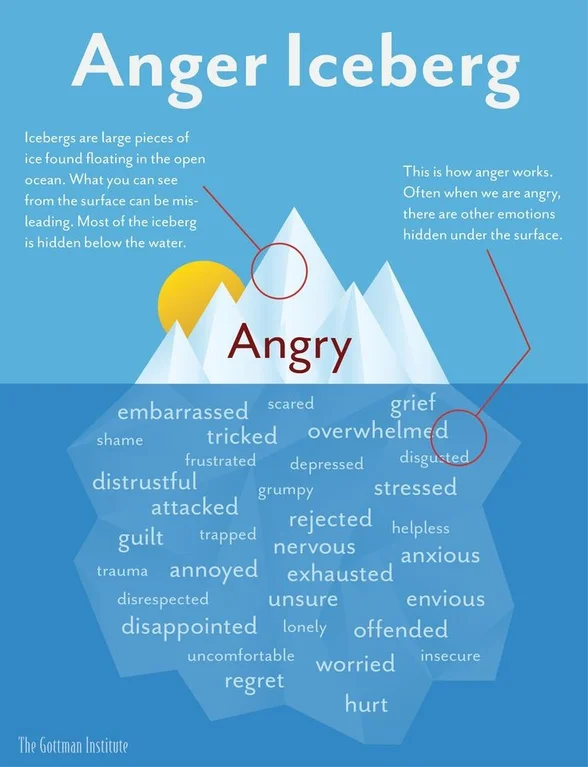
A major cause of anger and all other emotional reactions during interpersonal communications is mistaken interpretations, either wrong or distorted. This can also include positive interpretations.
For Buddhists, the second skandha (sensation) is the proximate cause of how we perceive (third skandha) forms (first skandha). The fourth and fifth skandhas (mental activity and consciousness) are how we consolidate or more often reconsolidate the original mistaken or distorted sensation. For more on this see: The Five Skandhas.
For non-Buddhists, if you watch your mind closely you will notice there is a short delay between receiving an impression and reacting to it, interpreting it.
For everyone, if you can be mindful of the second skandha (sensation) as it occurs and then interrupt the habitual firing of the next three skandhas by doing a FIML query, you will begin to truly observe how your mind (and your partner’s mind) really works. Each interruption of this type improves your mental and emotional functioning because you will observe an objective bit of reality and correct toward it. For more information see: Disruption of neurotic response in FIML practice and How the brain processes new information. ABN
A perfect moral, dramatic, pragmatic, linguistic, psychological, spiritual, and emotional act…
…is a proper FIML query.
It is perfect (in no special order) morally because it seeks truth and goodness between two people; dramatically because it uses our innate dramatic instinct to question our own deep sense of live drama in the moment; pragmatically because it is eminently practical; linguistically because it is an extremely good use of language, possibly the best use; psychologically because it benefits both the self and other in profound ways while also revealing deep behavioral patterns painlessly; spiritually because it stimulates the spirit and spiritual metacognition, bringing both partners closer to their ideals; and emotionally because it forestalls false negative and destructive emotional responses, replacing them with joyful understanding. FIML is a pursuit of truth shared by two people. It is a technique, a method, that can be used in any religion, philosophy, world-view, or lifestyle. In the beginning, FIML does not even depend on scrupulous truthfulness because the practice itself will reveal the value of truthfulness, which ultimately will require almost no effort. Truthfulness is an instinct or inkling of deepest consciousness. Once seen, it calls forth itself.
ABN
first posted NOVEMBER 5, 2021
Personality as persona
The word persona comes from Latin, where it originally meant a “theatrical mask.” In everyday usage today, we normally mean it to indicate a “social role” that, to some extent, most of us play consciously.
Carl Jung used the concept of persona to indicate the deep sense in which a person employs conscious and subconscious methods to present a social face, or mask, to the world.
Jung said of his use of the word persona that it is “a kind of mask, designed on the one hand to make a definite impression upon others, and on the other to conceal the true nature of the individual.” (C. G. Jung, Two Essays on Analytical Psychology London 1953 p. 190)
My understanding of Jung’s psychology is that he took the persona to be something more substantial—more real—than it need be. In my view, when we take our persona(s) too seriously, we reify them, even fetishize them.
Once fetishized or reified, the persona in Jungian psychology takes on almost supernatural qualities, eventually requiring “disintegration” followed after some time by “restoration” as a more conscious and reasonable thing that can serve both personal and social needs without painful contradictions.
I believe this Jungian sense of the term persona has had a considerable influence on our ordinary sense of what a personality is.
In this light, I would contend that what we commonly refer to as personality is a ghostly generalization that obscures both inner-private and outer-social reality.
Belief in “personality” removes analysis of interpersonal-being-in-this-world from actual specifics to nebulous generalities.
If you have a conflict or misunderstanding with a friend and either of you believes it is due to “personality differences,” you will tend to avoid the problem rather than fix it. You will avoid it because it is all but impossible to fix anything with such a vague notion as personalty.
Assuming the two friends just mentioned are close friends, they would do much better to identify the specific moment their misunderstanding occurred and work with that.
People today do not normally do this for two reasons: 1) almost everyone believes in something like “personality” and in so believing makes it impossible to fix even small moments of discord, and 2) very few people know how to fix those sorts of problems even if they do realize that more is going on than two ghostly persona clashing in a mystical realm.
I agree that people need personas to negotiate many social and professional environments. And I agree that most people have a few traits that often remain sort of constant over time and in similar contexts.
What I do not agree with is everything else we normally attribute to personalities. In place of all that, I would substitute the idea that humans are semiotic entities and that we communicate with each other and within ourselves by using semiotics and semiotic networks.
Our interests and training lead us to emphasize some parts of these networks over others, but this does not constitute a “personality” as the word is normally used.
Suffering arises when we experience bad communication. Belief in personalities masks (ironically) the true nature of communication problems. Belief in personalities causes us to generalize when we should be looking very closely at the specific moment during communication that the semiotic networks of the two (or more) communicators began to diverge.
That is the point at which their interpretations began to differ and nothing will explain why they began to differ except close analysis of that precise moment.
People do not analyze the precise moment their interpretations of each other began to differ because they do not know how. In place of analysis, people almost always generate strong emotions and within seconds make it impossible to analyze anything.
It is not your personality or theirs that does this. It is, rather, our lousy abilities to communicate, a problem everyone in the world has. We are like monkeys in a high-powered automobile all but doomed to crash, or go nowhere.
How to drive that car? How can we catch the specific moment interpersonal interpretations diverge? And how can we analyze that moment? Only FIML practice or something very much like it will allow us to do that.
Wasting time analyzing your personality or constructing an even better one will get you nothing more than a theatrical mask, a persona, that will be useful in some social situations but a disaster in all close interpersonal relationships.
first posted APRIL 17, 2014
What Really Happened During the Yellowstone Park Flood?
I found the narrator’s delivery quite interesting. For the length of the video he maintains a public face with a few conspicuous emotional expressions, also stock public semiotics. He comes across as an intelligent, kindly, nice-guy type. This may well be his persona in real life. What I want to point out is the burden of carrying a persona like this wherever you are, especially into your own home, your own world. In your private spaces, you can greatly improve your communication by doing FIML practice. Clearly, there is a more complex person behind the persona we see in the video. This is the part of us—our authentic being—that FIML works with. There are two difficulties in doing FIML: 1) you must have the ability to be trustworthy and you need to have a trustworthy partner that you care about and that cares about you; 2) you both have to learn how to overcome the universal taboo of stopping real-time speech to query the speaker directly about what they just said; you have to be able to do this and accept this when your partner does it to you. Point #1, sadly, can be the more difficult. Point #2 is difficult because it goes against what seems to be an instinct. It can be overcome fairly easily if we know there is a reason to do that. It is like overcoming a tendency to flinch where it is not needed. ABN
“The goal there is not just to crush me. The goal is to show people – don’t agree with this woman because if you do that you’re going against us and we can’t have that. This is the fate that you’ll face” – Eva Vlaardingerbroek
Originally tweeted by Wittgenstein (@backtolife_2023) on August 3, 2022.
Name-calling and ostracism as described by Vlaardingerbroek is a common form of mind-control used by legacy media and the state, which shows there is little difference between the two. During covid, “anti-vaxxer” was used in this way to frighten people away from what should have been a very ordinary and absolutely necessary debate about the vaccines, including knowing WTF is in them, something we still do not know. To be an aware citizen in today’s world you have to fully understand mind-control techniques and be able to stand your ground when they are used against you. ABN
To readers of ABN
ABN has gained many more readers since coverage of covid and other matters became of more pressing importance. They still are more pressing since our very existence as a free society is at stake.
That said, please do your best to understand and practice FIML with your spouse or best friend. FIML is a life-changing practice that will reveal the building blocks of both of your makeups in a most wonderful way.
Positive change through FIML is easy in the sense that each building block is small. Being small, they are easy to analyze and not difficult to accept if we see we are in the wrong. This promotes rapid incremental transformation for the better.
A little change here, a little change there, patterns are recognized and rather easily transformed into something much more adaptive, real, appropriate for your lives. No theory or concept of personality is necessary. No training in psychotherapy is necessary.
The simple dynamic of FIML done honestly and in friendship will help both of you feel much better and be much more authentic to yourselves. FIML is a process, a dynamic method. It has no other content save what you bring to it. ABN
American parasitism – a renaming, sequins
Our parasitic class(es) have grown so large and dominant, we need a name for the core people, the core group(s) without which we would not suffer such profound parasitic infestation and harm. To this end I propose the term sequins, which is a reasonable pronunciation of SQN — sine qua non, “without which nothing.”
Sequins are the core people, the top people who fund, organize, promote, and propagandize in their own interests, even though these interests are typically couched as being for “the greatest good,” which they are not. They are the people “without which” we would not suffer so much parasitism.
The World Economic Forum, for example, is a group of sequins, without question controlled by a more secret group of even stronger sequins. The Biden administration is clearly controlled, handled, run by sequins, many of whom went apeshit over Donald Trump because he threatens them.
I doubt this term will catch on, but maybe it will. We need something like this word to identify the top people behind our core problem. The terms people use with varying meaning today to sort of indicate what sequin means are not accurate and bring in many other associations that serve only to confuse the issue. ABN
An image that illustrates the value of FIML practice

FIML practice is like JWST compared to normal interpersonal speech, which is like Hale at best. Like the telescope, FIML is a technical advance that allows for much greater clarity and resolution. In Buddhist terms, FIML is partner-based mindfulness that provides an objective control on understanding in addition to much better clarity. ABN
Psychology as “signs of something else”
When we see a human behavior as a “sign of something else” we begin magnifying it.
When we live in a culture where people normally do this, we tend to think it is right to do this even to ourselves.
People often feel relieved when their “signs of something else” have been analyzed—either professionally or by self-administered questionnaires—to reveal what that “something else” is.
Once analyzed and categorized, the “something else” itself becomes a sign, or a meta-sign, a diagnosis that explains behavior while directing us to a cure based on whatever that “something else” is.
The DSM reads like a Ptolemaic system of circles and spheres. In it signs are identified, quantified, and classified to indicate what they stand for, what their “something else” is.
Professionals are needed to do this work of course, and though the manual rests on “scientific” tests and other measurements, it changes every few years and very few people are getting better because of it. Moreover there is very little consensus among thoughtful people, including psychologists, about what the classifications of “mental illness” or “personality disorder” actually mean.
This is a sure sign that something is wrong.
I submit that what is wrong is our systems of classification of mental disorder do not describe the actual disorders because these descriptions exist on a different level from the disorders themselves.
It is widely observed that many disorders as currently classified blend into each other, share attributes, are co-morbid. It is also widely known that when disorders are extreme, sufferers can exhibit symptoms of all of them.
This indicates that the human mind is a complex system that becomes disordered by over-emphasizing or under-emphasizing parts of its system.
And this may be why drugs, psychedelics, shock therapy, or shamanic rituals sometimes help. Because they reset the entire system.
If you don’t want to use drugs, can’t get psychedelics, don’t want to undergo shock therapy or shamanic ritual, I suggest you try FIML practice. If you have a good partner, are fairly intelligent, and want to truly optimize your psychology (not just terminate your ambiguous disorder), FIML will probably do this for you. In fact, even if you can get psychedelics, FIML is better.
A disorder is unique to its system and though we can speak of some generalities that may apply to it, these generalities exist at a different level from the disorder itself and cannot provide a cure.
To cure a disorder the disorder must be experienced as it is happening by the sufferer. If too much of the disorder is revealed at once or the sufferer is simply confronted with its classification, more harm than good may result. If small bits of the disorder are revealed over a longish period of time, however, the sufferer will be much more likely to gain beneficial insight into the disorder.
In my view, all people everywhere are deeply disordered and thus all people everywhere would benefit from FIML practice. People who may not benefit from FIML include, among others, those who cannot self-observe, who are severely alcoholic, whose disorder prohibits self-analysis (narcissism, for example) and, sadly, those who cannot find an honest partner.
first posted MARCH 14, 2018
Consider “diagnosing” a child as “trans” because some adult observed a “sign” that they are. If you listen to parents and teachers who just know some child, or even baby, is trans, you will always hear them say that something the child did, or said, or reacted to was a sure sign they are trans. This explanation is typically accompanied by a knowing smile on the adult’s face indicating an absurd sense of certainty based on their very mistaken notion of what perceived interpersonal signs even are. ABN
UPDATE: Psychology as a pseudoscience of sign misinterpretations has never been clearer or more tragic than with trans diagnoses of children leading to surgery or hormone therapy. ABN
Joe Biden’s kitchen table
The circle “what people actually understand” should be much larger and mostly outside the other circles

All you smart people, do FIML. ABN
The basis of Mass Formation (Psychosis)
“What one thinks does not matter; what counts is that people think it together. In this way, the masses come to accept even the most absurd ideas as true, or at least to act as if they were true.”
~ Mattias Desmet
Besides “mind control” and “psychology,” I am also filing this under “psycholinguistics” because what matters is that you accept the lying words of the mind controllers and sway in unison with the crowd upon hearing them. ABN
AI identifies speech patterns in children with autism that were consistent between English and Cantonese
…“When you have languages that are so structurally different, any similarities in speech patterns seen in autism across both languages are likely to be traits that are strongly influenced by the genetic liability to autism,” said Losh, who is the Jo Ann G. and Peter F. Dolle Professor of Learning Disabilities at Northwestern.
“But just as interesting is the variability we observed, which may point to features of speech that are more malleable, and potentially good targets for intervention.”
Lau added that the use of machine learning to identify the key elements of speech that were predictive of autism represented a significant step forward for researchers, who have been limited by English language bias in autism research and humans’ subjectivity when it came to classifying speech differences between people with autism and those without.
link
 American Buddhist Net