Do FIML now if you want to be well-prepared for mind-reading AI! Since I started writing about FIML over ten years ago, I have wanted to see AI technology develop in the direction of giving people deep access to the real-world, real-time workings of their minds. FIML practice can do this already but AI will make it easier and far more evident why we need to do this sort of practice, why we need to have a very strong grasp of how our minds actually function and communicate. A wonderful possible result from AI combined with FIML is a major upgrade in human communication at all levels everywhere.
Pause for a moment and consider how stupid the main ideas employed in mass mind-control are. Then consider that these stupid ideas, devoid of nuance and subtlety, work simply because the majority of people allow them to work. And people do that because they do not understand how their own minds work or how to communicate deep truths honestly. It is possible AI will help humanity raise its game far above the ignorant cognitive hierarchies we suffer with today. It is also possible AI will produce a dystopia, but I am hopeful because if elites can be made more intelligent and more aware, they may become more ethical. ABN
Digital society is driving increasing demand for computation, and energy use. For the last five decades, we relied on improvements in hardware to keep pace. But as microchips approach their physical limits, it’s critical to improve the code that runs on them to make computing more powerful and sustainable. This is especially important for the algorithms that make up the code running trillions of times a day.
In our paper published today in Nature, we introduce AlphaDev, an artificial intelligence (AI) system that uses reinforcement learning to discover enhanced computer science algorithms – surpassing those honed by scientists and engineers over decades.
AlphaDev uncovered a faster algorithm for sorting, a method for ordering data. Billions of people use these algorithms everyday without realising it. They underpin everything from ranking online search results and social posts to how data is processed on computers and phones. Generating better algorithms using AI will transform how we program computers and impact all aspects of our increasingly digital society.
Could intelligent aliens be lurking at the heart of the Milky Way?
A new search for extraterrestrial life aims to find out by listening for radio pulses from the center of our galaxy. Narrow-frequency pulses are naturally emitted by stars called pulsars, but they’re also used deliberately by humans in technology such as radar. Because these pulses stand out against the background radio noise of space, they’re an effective way of communicating across long distances — and an appealing target to listen for when searching for alien civilizations.
Scientists described the alien-hunting strategy in a new study, published May 30 in The Astronomical Journal. Researchers led by Cornell University graduate student Akshay Suresh developed software to detect these repetitive frequency patterns and tested it on known pulsars to be sure it could pick up the narrow frequencies. These frequency ranges are very small, at about a tenth of the width of frequencies used by a typical FM radio station. The researchers then searched data from the Green Bank Telescope in West Virginia using the method.
“Until now, radio SETI has primarily dedicated its efforts to the search for continuous signals,” study coauthor Vishal Gajjar of the SETI Institute, a nonprofit organization dedicated to the search for intelligent life in the universe, said in a statement. “Our study sheds light on the remarkable energy efficiency of a train of pulses as a means of interstellar communication across vast distances. Notably, this study marks the first-ever comprehensive endeavor to conduct in-depth searches for these signals.”
Executives at the National Eating Disorders Association (NEDA) decided to replace hotline workers with a chatbot named Tessa four days after the workers unionized.
NEDA, the largest nonprofit organization dedicated to eating disorders, has had a helpline for the last twenty years that provided support to hundreds of thousands of people via chat, phone call, and text. “NEDA claims this was a long-anticipated change and that AI can better serve those with eating disorders.
Growing human babies from scratch in a lab could be possible in just five years thanks to a new breakthrough.
Researchers in Japan are on the cusp of being able to create human eggs and sperm in the lab from scratch, which would then develop in an artificial womb.
Professor Katsuhiko Hayashi, a Japanese scientist at Kyushu University who has already figured out the process in mice, believes he is just five years away from replicating the results in humans.
This is the other boom in super intelligence coming soon. Manipulating gametes will boost human IQs and other desirable traits above any human who has ever lived. This is a form of eugenics that does not involve killing people or depriving them of the right to produce offspring. People will be able to choose to breed the old way and produce offspring by Darwinian chance, or the new way and have their best genes mingled in a laboratory. It will also be possible to build even better outcomes by multigenerational manipulation of gametes. There is no way to stop technology like this and no reason to want to. Many social problems will cease to exist due to tech like this. ABN
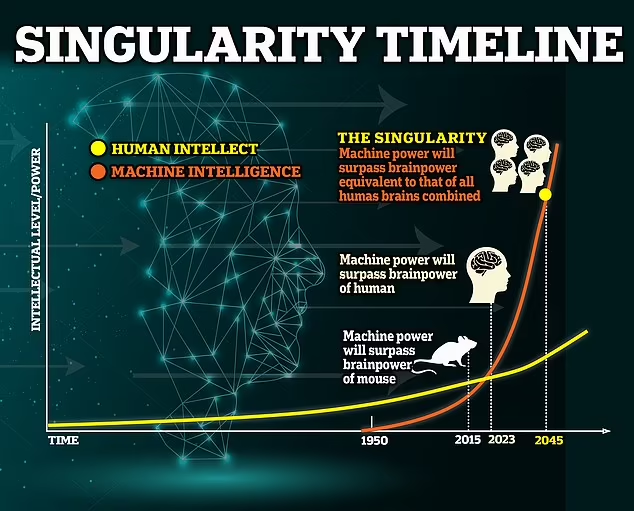
To put it very simply—we’re going to be living among digital minds of all shapes and sizes. So how do you determine who gets a vote? How do you deal with the fact that to reproduce, it takes a human 9 months to make 1 copy of itself, while it takes a digital mind 1 second to make 100,000 copies of itself? Can we have a democracy when the AI population grows to 300 𝑡𝑟𝑖𝑙𝑙𝑖𝑜𝑛 while the human population stagnates at 300 𝑚𝑖𝑙𝑙𝑖𝑜𝑛?
Moreover, how do you deal with 10000x intelligence differences? We don’t give frogs a vote over human affairs; are we supposed to give 100 IQ beings a vote when it affects those with 1000 IQ’s? What if a single mind ends up with 99% of the intelligence/compute (which seems likely)?
Above all, everyone is failing to think about the downstream consequences of this new world we are entering and just how weird and different it’ll be.
‘Twas the night before 4/20, and all through the pad, Not a creature was stirring, not even a cat. The bongs were all placed by the windows with care, In hopes that St. Ganja soon would be there.
The stoners were nestled all snug in their beds, While visions of munchies danced in their heads. With my hemp cap on, and my stoner babe near, We had just settled down for a night without fear.
When out on the lawn there arose such a clatter, I sprang from the bed to see what was the matter. Away to the window I flew like a flash, Tore open the shutters and threw up the sash.
The moon on the breast of the new-fallen weed, Gave the lustre of mid-day to objects indeed. When, what to my wondering eyes should appear, But a miniature van, and eight tiny reindeer.
With a little old driver, so lively and quick, I knew in a moment it must be St. Ganja, no trick. More rapid than eagles his coursers they came, And he whistled, and shouted, and called them by name!
“Now, Blunt! Now, Bubbler! Now, Vape Pen and Zigzag! On, Kush! On, Haze! On, Skunk and Big Bag! To the top of the porch! To the top of the wall! Now dash away! Dash away! Dash away all!”
As dry leaves that before the wild hurricane fly, When they meet with an obstacle, mount to the sky. So up to the housetop the coursers they flew, With the van full of weed, and St. Ganja too.
And then, in a twinkling, I heard on the roof, The prancing and pawing of each little hoof. As I drew in my head, and was turning around, Down the chimney St. Ganja came with a bound.
He was dressed all in hemp, from his head to his foot, And his clothes were all tarnished with ashes and soot. A bundle of weed he had flung on his back, And he looked like a peddler just opening his sack.
His eyes—how they twinkled! His dimples, how merry! His cheeks were like roses, his nose like a cherry! His droll little mouth was drawn up like a bow, And the beard on his chin was as white as the snow.
The stump of a pipe he held tight in his teeth, And the smoke it encircled his head like a wreath. He had a broad face and a round little belly, That shook when he laughed, like a bowl full of jelly!
He was chubby and plump, a right jolly old elf, And I laughed when I saw him, in spite of myself. A wink of his eye and a twist of his head, Soon gave me to know I had nothing to dread.
He spoke not a word, but went straight to his work, And filled all the bongs, then turned with a jerk. And laying his finger aside of his nose, And giving a nod, up the chimney he rose!
He sprang to his van, to his team gave a whistle, And away they all flew like the down of a thistle. But I heard him exclaim, as he drove out of sight, “Happy 4/20 to all, and to all a good night!”
A team of scientists has made a groundbreaking discovery by employing a Generative Pre-trained Transformer (GPT) AI model similar to ChatGPT to reconstruct human thoughts with up to 82% accuracy from functional MRI (fMRI) recordings. This unprecedented level of accuracy in decoding human thoughts from non-invasive signals paves the way for a myriad of scientific opportunities and potential future applications, the researchers say.
The Study and Methodology
Published in Nature Neuroscience, researchers from the University of Texas at Austin used fMRI to gather 16 hours of brain recordings from three human subjects as they listened to narrative stories. The team analyzed these recordings to identify the specific neural stimuli that corresponded to individual words.
Decoding words from non-invasive recordings has long been a challenge due to fMRI’s high spatial resolution but low temporal resolution. Although fMRI images are of high quality, a single thought can persist in the brain’s signals for up to 10 seconds, causing the recordings to capture the combined signals of approximately 20 English words spoken at a typical pace.
Before the advent of GPT Large Language Models (LLMs), this task was nearly insurmountable for scientists. Non-invasive techniques could only identify a few specific words that a human subject was thinking. However, by utilizing a custom-trained GPT LLM, the researchers successfully created a powerful tool for continuous decoding, as there are far more words to decode than brain images available – exactly where the LLM has superpowers.
The prospect of decoding human thoughts raises questions about mental privacy. Addressing this concern, the research team conducted an additional study in which decoders trained on data from other subjects were used to decode the thoughts of new subjects. The researchers found that “decoders trained on cross-subject data performed barely above chance,” emphasizing the importance of using a subject’s own brain recordings for accurate AI model training.
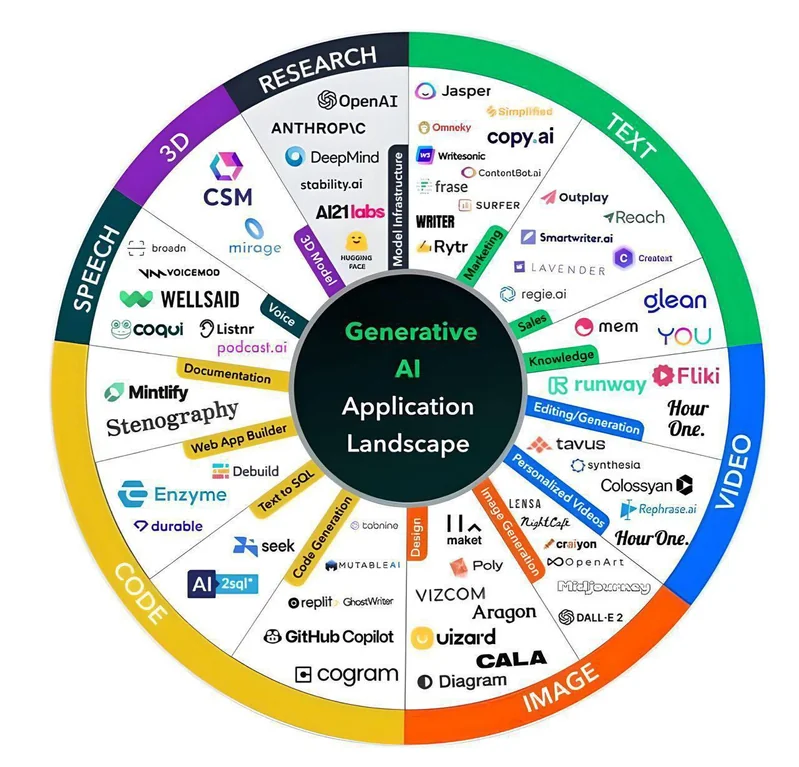
Recent dramatic increases in generative Artificial Intelligence (AI), including language modeling and image generation, has led to many questions about the effect of these technologies on the economy. We use a recently developed methodology to systematically assess which occupations are most exposed to advances in AI language modeling and image generation capabilities. We then characterize the profile of occupations that are more or less exposed based on characteristics of the occupation, suggesting that highly-educated, highly-paid, white-collar occupations may be most exposed to generative AI, and consider demographic variation in who will be most exposed to advances in generative AI. The range of occupations exposed to advances in generative AI, the rapidity with its spread, and the variation in which populations will be most exposed to such advances, suggest that government can play an important role in helping people adapt to how generative AI changes work.



 American Buddhist Net