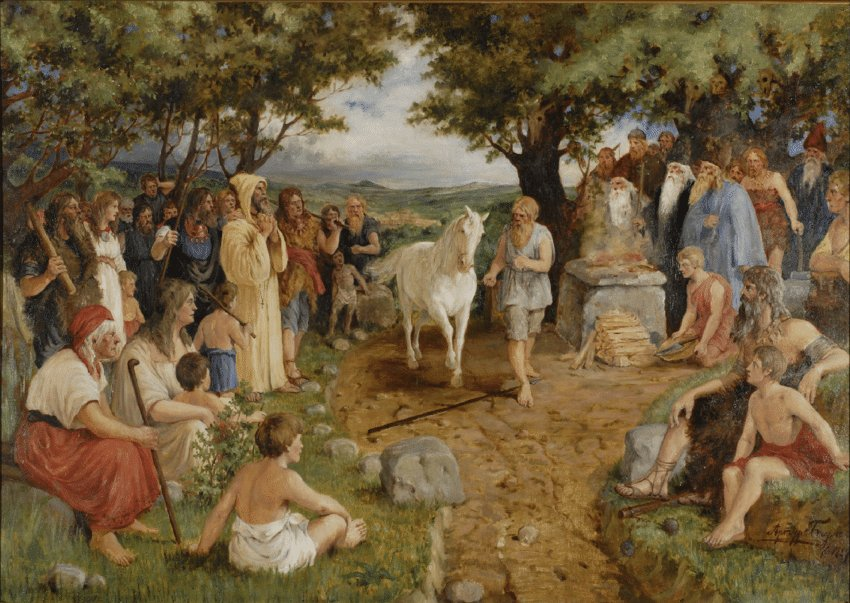
At Marvelė in Kaunas there is a pagan horse cemetery with around 300 horses, most dating to the Viking Age. They had their own section, separate from nearly 1,600 human graves.
Some were buried with bridles, bells and riding gear, sometimes several in one grave. At least one horse had been brought across the Baltic, probably from Sweden.
Around 2,000 horse burials are known in Lithuania. The tradition lasted from roughly the 3rd to the 14th century, longer than anywhere else in Europe.
Lithuania, a tiny country today, still carries some of Europe’s oldest genes, attributable to the earliest hunter-gatherers who populated Europe at the end of the last ice age, some 10,000 years ago. The Lithuanian language is the oldest still-spoken Indo-European language in the world; it closely resembles ancient Sanskrit, which indicates an Aryan creole admixture with Lithuanian hunter-gatherers approximately 5,000 years ago. Sadly, Lithuania has recently begun receiving and paying for ‘refugees’ from South Asia and Africa who will soon overwhelm the Lithuanian population, which stands at a mere 2.8 million souls. Lithuania survived two centuries of Czarist Russian occupation and decades of occupation under the Soviet Union. During those times, they steadfastly maintained their culture, language and genetic stock. Today, under the EU (a morphed version of the SU) Lithuania is facing cultural and genetic annihilation within a few generations. It’s a microcosm of what is happening to Europe and the West. Each Western nation and each Western region is being ushered to the chopping block by hostile forces they cannot stop or control. ABN


 American Buddhist Net