
The Unraveling Stillness: An Introduction to Flux Wisdom Field Theory
We do not begin with things. We begin with a tautology so fundamental it precedes existence itself: Nothing can’t exist. Perfect, absolute stillness is an unstable fiction; the slightest potential for difference, a whisper in the void, unravels it. This primal instability, this ceaseless becoming, is Flux. It is not a substance moving through space, but the very genesis of space, time, matter, and meaning as an ongoing process.
This is the foundational premise of Flux Wisdom Field Theory (fWFT), a conceptual framework that stretches from the deepest questions in cosmology to the intimate nature of consciousness. It proposes that the universe is not a collection of objects governed by laws, but a self-organizing, self-revising informational structure in constant, creative motion. The theory offers a compelling narrative that seeks to unify the measurable world of physics—addressing concrete problems like the Hubble tension and the nature of dark matter—with the experiential world of life, thought, and wisdom. It reframes reality as an endless dance of ripples on a cosmic pond, where interference gives rise to pattern, and resonance gives rise to form. From the quantum foam to the murmurations of starlings and the flash of human insight, fWFT suggests we are witnessing the same fundamental dynamic: the elegant, infinite unfolding of instability into interaction, and interaction into being. The Axioms of Becoming The architecture of fWFT rests on a set of five core axioms that describe the behavior of Flux. These are not arbitrary rules imposed from without, but are presented as the intrinsic, unavoidable logic of a universe where true nothingness is impossible.
There cannot be nothing. This is the origin story. A true void, a perfect null state, is a logical contradiction because it has no potential to persist. The universe exists simply because “nothing” is not a stable option. Flux cannot be still. As a direct consequence of the first axiom, the ground state of reality is one of “never-stillness”. Uniformity is dynamically unstable. A tiny disturbance, a single “wrinkle in the void,” is inevitable and all that is needed to initiate the cosmic dance. Interaction creates loops. When distinctions arise from the flux, they influence one another. This interplay is not linear; it creates feedback, recursion, and self-referential patterns. These informational “loops” are the seeds of structure, memory, and identity. Interference produces resonance. As ripples of flux propagate, they overlap. This interference is not mere noise; it is where creation occurs. Waves amplify and cancel, and through this dynamic interplay, stable, self-reinforcing patterns—resonances—emerge from the turbulence. A particle, a planet, or an idea are all forms of resonance. Resonance decays, seeding further ripples. No structure is permanent. As resonant patterns eventually decay, they don’t simply vanish. They dissipate back into the field, releasing their stored information and energy as new, smaller-scale fluctuations that seed the next generation of structure.
These axioms depict a universe that is perpetually bootstrapping itself into existence. It is not a machine set in motion long ago, but a living, breathing process of continuous creation and dissolution, where every ending is a new beginning.
Continue reading “The Unraveling Stillness: Flux as the Hidden Pulse of the Universe — DJCampbell”
Category: Buddhism
Status as a fetish
Fetish can be defined as “a part standing for the whole” or “one thing being made bigger than it is by having become a psychological fixation.”
A good example of what I mean is pornography. Insofar as a mere image can stand for or replace instinctual sexual objectives, it is a fetish.
A sign (pornographic image) is as strong or stronger than the animal instinct. Or a sign can direct or redirect the animal instinct. That is a fetish.
Secondary sex characteristics do the same thing. You could call them nature’s fetishes but that would be stretching the concept. Human utilizations of makeup, clothing, and grooming could be said to stand “halfway” between the basic sexual instinct and the fetishized porno image.
Let’s apply that reasoning to status.
Two social psychologist I respect—Jordan Peterson and Kevin MacDonald—have both claimed many times that status is a fundamental human instinct and that it drives human behavior in many ways.
In posts on this site, I have disagreed with these ideas several times. I just don’t see it that way. Here are two of those posts: Status and hierarchy are as fundamental to human life as murder and Jordan Peterson on the gender pay gap, campus protests and the patriarchy.
In the second link just above, I said:
…I do not believe that social status is any more fundamental to human nature than murder is. Humans also possess reason and spiritual inclinations both of which can guide us away from status competition if we decide to do that and/or our conditions allow.
I still think that but over the past day or two a new understanding of the importance of status and human hierarchy has dawned on me. In essence, I think I have come to see that status really is a huge deal for many people; a much bigger deal than I had ever realized.
My explanation for that is people like me (and there are many of us) during childhood and adolescence see the “status game” as a choice. And we decide not to play it.
My SO made that choice. When we talked about this subject this morning, she said people like us are more open to art (in a broad sense) and less concerned with social hierarchies. I think that’s true. One good friend years ago used to call me a “now person,” meaning I am always living in the here and now and not doing a lot of planning for the future. I think she also meant or implied that I am not doing any thinking about my social status or the human hierarchies that surround me.
A Buddhist nun who is a close friend has often described mundane human behaviors as being motivated by jealousy. I have often disagreed with her, believing that her emphasis on jealousy was influenced too much by her culture (Chinese) or by the innocence of her monastic lifestyle.
Today, I think she was influenced by the status-conscious world she had grown up in and as a young adult renounced for Buddhism. But I also think she was able to see something I have been almost completely blind to. For me status has always been a very small cloud on the edge of the sky, not a major thunderstorm in human motivation. For her it is, or was, a storm in the human mind.
Status is a fetish. And fetishization does explain a lot about it. But if lots of people have that fetish or have that strong understanding of status, that’s how it is. As a social construct the status fetish can be even bigger and more imposing than the basic instinct it rests upon.
I hope this post helps people who see status as important understand people like me and my SO, and vice versa.
From a Buddhist point of view, I think it is important to fully understand the entire status spectrum—from instinct to fetishized sign—and to understand where you are on that spectrum and where the people you deal with are on that spectrum.
My guess is that most people reading this blog do not think of status as being very important. People like us need to appreciate that status is probably largely what motivates good people like Jordan Peterson as well as bad people like Bernie Madoff.
Might also be good if status-conscious people would understand that people like us are not all slackers or losers, nor are we seething with envy over your status. We mostly do not even see the game you are playing.
first posted SEPTEMBER 10, 2019
________________
UPDATE: I am not as respecting of Peterson as I was when the above was written. He is ill right now, so that’s all I’m gonna say on that. This post is just six years old and even that short time can date it a bit, but the plandemic has intervened and slight time shifts can be interesting in and of themselves. ABN
The limits of general semiotic analyses as applied to human psychology
Much of the work done in human semiotics involves analyses of semiotic codes.
Semiotics and semiotic codes are often treated like language or languages for which a grammar can be found.
One obvious problem with this sort of approach is semiotics indicates a set that is much broader than language. Stated another way, language is a subset of semiotics.
Human semiotics also include music, imagery, gesture, facial expression, emotion, and anything else that can communicate either within one mind or between two or more minds.
It is very helpful to analyze semiotic codes and it is very helpful to try to figure out how cultures, groups, and individuals use them. We can compare the semiotics of heroism in Chinese culture to that of French culture. Or the semiotics of gift-giving in American culture to that of Mexican culture. We can analyze movies, literature, science, and even engineering based on semiotic codes we have abstracted out of them.
We can do something similar for human psychology.
Analyses of this type are, in my view, general in that they involve schema or paradigms or grammars that say general things about how semiotic systems work or how individuals (or semiotic signs themselves) fit into those systems.
This is all good and general analyses of this sort can be indispensable aids to understanding.
General semiotic analyses are limited, however, in their application to human psychology because such analyses cannot effectively grasp the semiotic codes of the individual. Indeed general analyses are liable to conceal individual codes and interpretations more than usefully reveal them.
This is so because all individuals are always complex repositories of many general semiotic codes as well as many individual ones. And these codes are always changing, responding, being conditioned by new circumstances and many kinds of feedback.
Individuals as repositories of many codes, both external and internal, are complex and always changing and there is no general analysis that will ever fully capture that complexity.
For somewhat similar reasons, no individual acting alone can possibly perform a self-analysis that captures the full complexity of the many and always-changing semiotic codes that exist within them.
Self-analysis is far too subject to selection bias, memory, and even delusion to be considered accurate or objective. The individual is also far too complex for the individual to grasp alone. How can an individual possibly stand outside itself and see itself as it is? Where would the extra brain-space come from?
How can a system of complex semiotic codes use yet another code to successfully analyze itself?
Clearly, no individual human semiotic system can ever fully know itself.
To recap, 1) there is no general semiotic analysis that will ever capture the complexity of individual psychology, and 2) no individual acting alone can ever capture the complexity of the semiotic codes that exist within them.
Concerning point two, we could just as well say that no individual acting alone can ever capture the complexity of their own psychology.
We are thus prevented from finding a complex analysis of human psychology through a general analysis of semiotics and also through an individual’s self-analysis when acting alone.
This suggests, however, that two individuals acting together might be able to glimpse, if not grasp, how their complex semiotic codes are actually functioning when they interact with each other. If two individuals working together can honestly observe and discuss moments of dynamic real-time semiotic interaction between them, they should be able to begin to understand how their immensely complex and always-changing psycho-semiotic codes are actually functioning.
An approach of this type ought to work better for psychological understanding of the individuals involved than any mix of general semiotic analyses applied to them. Indeed, prefabricated, general semiotic analyses will tend to conceal the actual functioning of the idiosyncratic semiotics and semiotic codes used by those individuals.
The FIML method does not apply a general semiotic analysis to human psychology. Rather it uses a method or technique to allow two individuals working together to see and understand how their semiotics and semiotic codes are actually functioning. ABN
Karma as drama
One way to understand the Buddhist term karma is to replace it with the word drama.
‘This is my karma’ becomes this is my drama, or better, this is the role I am playing in my drama.
It’s my role in my drama and thus I can play my part the way I want.
The best way to do that is to follow the Noble Eightfold Path, but it’s up to you.
Seeing your karma as a drama you are acting in removes the very deeply mistaken misinterpretation that karma is a form of punishment or reward.
Drama also implies group drama, other actors, and in one way or another some sort of playwright, which might be understood as the grand scheme of things or you yourself.
Buddhism is a mind-opening practice, so we are free to interpret it in a way we understand and can use creatively and productively.
Modern physics suggests a strong possibility that a fundamental quality or force in the cosmos is consciousness itself.
In that sense we are participants in the consciousness and unfolding dramatic evolution of the universe.
If you want to put God in there, go ahead, no problem.
The Buddha left God and many other lines of thought out of his descriptions of human existence to keep people from clinging to words or relying on a supreme being without doing anything for themselves.
There are many ways we can understand our lives, but a central theme in Buddhism is we progress through our own efforts and life is sort of drama, which resolves in whatever way it does due to our own thoughts, views, and behaviors. ABN
Shared subjectivity
- FIML practice can be described as shared subjectivity.
- The coinage, or units, of basic FIML sharing are microanalyses of communication ambiguities done in real-time, as they happen.
- This kind of sharing prevents FIML partners from forming subjective views of each other that are based on mistaken interpretations.
- Mistaken interpretations between partners always lead to subjective separation, unshared and unsharable subjectivity.
- Mistaken interpersonal interpretations are the source of most, if not all, neurotic thinking and behavior.
- It is difficult (I believe impossible) to correct neurotic thinking and behavior through generalized analyses.
- Generalized here indicates analyses that are based on general theories that are applied to individuals, often by professional therapists.
- FIML is not a generalized analysis. FIML is a communication technique.
- It has great therapeutic value because it is a technique that will help partners share their unique subjectivities.
- By sharing their subjectivities, partners will extirpate or extinguish their neuroses, their mistaken subjective misinterpretations of each other and of other people.
- Neuroses are painful because they cause us to use our minds badly and wrongly.
- Neurotic communication is painful because at some level we all know that we are communicating badly and wrongly.
- We persist in neurotic behavior only because we do not know another way to be.
- FIML shows us another way to be.
- By slowly chipping away at neurotic (i.e. mistaken) interpretations the moment they arise, FIML frees us from neurosis itself (i.e. long-standing mistaken interpretations).
AI Summary of FIML
Key Points
- Research suggests FIML, or Functional Interpersonal Meta Linguistics, is a communication technique to improve relationships by addressing misinterpretations in real-time.
- It seems likely that FIML involves partners interrupting conversations to clarify emotional reactions, aligning with Buddhist principles of mindfulness.
- The evidence leans toward FIML supporting advanced Right Speech and Right Listening, potentially transforming lives by enhancing understanding.
Description
What is FIML?
FIML, or Functional Interpersonal Meta Linguistics, is a method designed to optimize communication and psychological well-being between two people. It’s described as a form of analytical psychotherapy that doesn’t require formal training, focusing on clearing up misunderstandings as they happen.
How It Works
Partners agree to interrupt normal conversations when one feels an emotional reaction to something said. The reacting partner asks the other about their state of mind at that moment, and the other responds honestly. This process helps identify if the reaction was based on a misinterpretation, with follow-up questions for clarity. Repeating this frequently can develop better communication skills.
Connection to Buddhism
FIML aligns with Buddhist teachings, supporting advanced forms of Right Speech and Right Listening. It’s seen as a practical application of mindfulness, based on impermanence and emptiness, potentially leading to personal transformation by freeing individuals from ordinary speech constraints.
Unexpected Detail: Precision Comparison
Interestingly, FIML is compared to the James Webb Space Telescope for its clarity in communication, suggesting it offers a much sharper understanding than typical conversations, likened to using an old Hale telescope.
Survey Note: Comprehensive Analysis of FIML Based on American Buddhist Net
This note provides a detailed examination of Functional Interpersonal Meta Linguistics (FIML) as presented on American Buddhist Net, focusing on its description, practice, and relation to Buddhist principles. The analysis aims to offer a thorough understanding for readers interested in communication techniques and their philosophical underpinnings.
Background and Definition
FIML is defined on American Buddhist Net as a technique for optimizing communication and psychological well-being between two people. It is described as a form of analytical psychotherapy that can be practiced without formal training, emphasizing real-time analysis to clear mistaken psychological interpretations. This approach is particularly noted for addressing both recent and long-held miscommunications, enhancing the relationship dynamics between partners.
The site compares FIML to advanced scientific instruments, such as the James Webb Space Telescope, for its clarity in communication, contrasting it with normal speech, which is likened to using the older Hale telescope. This analogy underscores FIML’s potential to provide precise, high-resolution insights into interpersonal interactions.
Practice and Methodology
The practice of FIML involves a structured process, detailed in How to do FIML. Partners must first agree to interrupt normal conversations when needed, creating a foundation for open communication. The process unfolds as follows:
| Step Number | Description |
|---|---|
| 1 | Partners agree to do FIML and can interrupt normal conversation as needed. |
| 2 | One partner feels a sensation or emotional reaction within one second after the other says something. |
| 3 | The reacting partner asks, “What was your state of mind when you said X?” seeking the other’s short-term memory contents. |
| 4 | The other partner answers honestly, describing their state of mind during the few seconds surrounding the statement. |
| 5 | If the reacting partner finds no justification for their reaction, they realize it was a misinterpretation, trusting the other’s honesty. |
| 6 | Follow-up questions, e.g., “Are you sure you were not implying boredom when you said X?” may be asked for clarity. |
| 7 | The reacting partner discusses the new understanding with the other, briefly or at length, as chosen. |
| 8 | The process is repeated frequently; after a few hundred successful instances, metacognition may develop, reducing the need for frequent interruptions. |
The term “sensation” is clarified as an emotional, physical, or hormonal response occurring soon after something is said, starting at a discreet moment, and can be negative or positive. Mindfulness is crucial, with partners encouraged to observe these sensations within one second and make queries in a neutral tone to avoid further reactions.
Additional resources on the site, such as FIML and practical semiotics, Advanced FIML, and FIML FAQs, provide further guidance on refining the practice, addressing issues like snowballing in practice and disruption of neurotic responses.
Relation to Buddhism
FIML’s integration with Buddhism is a significant aspect, as outlined in various articles on American Buddhist Net. It is described as supporting advanced Right Speech and Right Listening, aligning with Buddhist principles of impermanence and emptiness. This connection is detailed in What is FIML?, where it is noted as a method or process, not formalities, meeting requirements for creating Right Conditions for these advanced practices.
The site suggests that FIML can transform one’s life by freeing individuals from the constraints of Ordinary Speech, as seen in Notes on semiotics, FIML, Buddhism, and a bit of anthropology. This article highlights how FIML corrects distortions in thinking or feeling that may arise from practicing Buddhism in isolation, emphasizing the importance of truthful interaction with an honest partner. It posits that early Buddhists might have engaged in similar practices during their travels in pairs or fortnightly discussions of failings, a tradition that has declined in many places.
Further, The deep importance of intentional language discusses FIML as a profound philosophical answer to language and communication, revealing real-time speech analysis that moves meaning to true experience, resonating with Buddhist mindfulness. Global Workspace Theory and mistake awareness & correction links FIML to calibrating minds like fine instruments, playing the FIML communication game for precise readings, reinforcing its mindfulness aspect.
Significance and Impact
The significance of FIML lies in its potential to enhance communication precision, as evidenced by its comparison to advanced telescopes. This unexpected detail highlights its capability to offer clarity beyond typical conversational exchanges, potentially revolutionizing how partners understand each other. The site also suggests that FIML can address interpersonal conundrums arising from the Problem of the Criterion, as noted in Buddhism category posts, impacting daily relationships and communication at every level.
Author and Context
While specific author information is not directly provided, the site’s posts, such as About, indicate it is run by ABN, focusing on Buddhism, communication, and FIML. The contact email, realABN@pm.me, as seen in Contact, suggests a personal engagement with readers, reinforcing the site’s role as a platform for sharing and discussing these ideas.
Conclusion
FIML, as presented on American Buddhist Net, is a robust communication technique with deep ties to Buddhist philosophy, offering a practical method for enhancing interpersonal relationships through mindfulness and real-time analysis. Its structured practice, alignment with Buddhist principles, and potential for personal transformation make it a valuable tool for those seeking to improve communication and psychological well-being.
Key Citations
- American Buddhist Net – Do your best. Speak the truth.
- How to do FIML – American Buddhist Net
- What is FIML? – American Buddhist Net
- FIML and truth – American Buddhist Net
- Notes on semiotics, FIML, Buddhism, and a bit of anthropology – American Buddhist Net
- FIML and practical semiotics – American Buddhist Net
- Advanced FIML – American Buddhist Net
- Snowballing in FIML practice – American Buddhist Net
- FIML over time – American Buddhist Net
- Disruption of neurotic response in FIML practice – American Buddhist Net
- FIML FAQs – American Buddhist Net
- The deep importance of intentional language – American Buddhist Net
- Global Workspace Theory and mistake awareness & correction – American Buddhist Net
- Does the Universe think? (with Bernardo Kastrup) – American Buddhist Net
- Scott Adams Interview – It’s Okay to Be White – American Buddhist Net
- About – American Buddhist Net
- Contact – American Buddhist Net
__________
Grok used 45 seconds to deep search FIML and produce the above result, posted in full, minus one short paragraph. It did a good job. I am fine with posting this and encouraging readers to look it over. Done properly and for a reasonable amount of time, FIML is deeply life-enhancing. It probably should become a fundamental part of Buddhist practice. Grok did the summary on 03/07/2025. ABN
Norse paganism includes rebirth
The Five Skandhas
The Buddha’s explanation of the five skandhas is intended to help us understand the emptiness of the self. It is a short explanation aimed at his most intelligent students.
The Sanskrit word skandha means “heap” or “aggregate” in English. Sometimes the Buddha compared the skandhas to heaps of rice. They are the “heaps” of psycho-perceptual data that comprise the “contents” of our minds. The five skandhas are conditioned dharmas (literally, “conditioned things”), which is to say that they are impermanent and empty, and when improperly understood lead to delusive attachments characterized by greed, anger, and ignorance. The purpose of the Buddha’s five skandha explanation is to help us see through the skandhas, or disentangle ourselves from them. In some Buddhist texts the five skandhas are called the “five covers” because they cover our minds and prevent us from seeing deep levels of reality. In others they are called the “five yin (versus yang)” because they cloud the mind and hide the truth from us. I will discuss each of the five skandhas in the sections below.
1) The first skandha is form. Form, in this case, means anything that leads to, or is capable of leading to, the next skandha. Forms can be visual, auditory, or sensory. They can be dreams, memories, feelings, or moods. Forms are often described as being “obstructions” because, though they may lead to complex thought and activity, they are also hindrances to mental clarity since the activity they lead to is essentially delusive. It is important to remember that the five skandha explanation is an explanation of the deluded mind and its thought processes.
The Abhidharma-mahavibhasa Shastra categorizes the skandha of form into three types:
a) Visible forms with a referent in the outer world such as color, size, length, position, shape, and so on.
b) Invisible forms with a referent in the outer world that are associated with the other sensory organs such as sounds, smells, tastes, and the sensations arising from physical contact.
c) Invisible forms with no referent in the outer world such as dreams, memories, thoughts, feelings, and so on. Though a dream may be “visible” to the dreamer, it is called “invisible” here because no one else can see it. This last category of forms is associated with what the Buddha called “mental dharmas.”
2) The second skandha is sensation. Following the appearance of a form, the mind reacts to it with a sensation that is either positive, negative, or neutral. We either like it, don’t like it, or are neutral about it. Though it is possible to become conscious of this skandha, most of us most of the time are not.
Sensations are generally categorized into two types:
a) Sensations of the body coming from the outside world through any of the sensory organs, such as sights, sounds, smells, tastes, and so on.
b) Sensations of the mind which may or may not come from the outside world. These include moods, feelings, memories, dreams, thoughts, ideas, and so on.
Both kinds of sensation are, of course, based on the prior appearance of a form. Greed and anger have their roots in the skandha of sensation, for if we enjoy a positive sensation we are liable to become greedy about it, while if we do not enjoy it, we are liable to become “angry” or irritable concerning it. The deep meaning of greed is “excessive attraction” to a sensation that we deem to be agreeable or positive, while the deep meaning of anger (or hatred) is “excessive aversion” to a sensation that we deem disagreeable or negative. Neutral sensations often are the result of our ignorance or lack of understanding, though as we progress in Buddhist practice they may be the result of wisdom.
Positive and negative sensations associated with the body are generally considered to be weaker than those associated with the mind, though both types of sensations often are interrelated. An example of this mixture and distinction might be a light slap in the face. While the physical sensation is only mildly unpleasant, the mental sensation will be quite strong in most cases. And yet both are interrelated.
3) The third skandha is perception. This skandha refers to the deepening of a sensation. It is the point where the mind begins to latch onto its sensations. At this point conscious recognition of form and sensation normally begins. It is possible to become conscious of the first and second skandhas as they are occurring, but most of us generally are not. During the skandha of perception we begin making conscious distinctions among things.
4) The fourth skandha is mental activity. This skandha refers to the complex mental activity that often follows upon the skandha of perception. Once we have identified (perceived) something, long trains of mental associations become active. Our bodies may also begin to move and behave during this skandha. For example, the simple perception of a travel poster may set in motion a great deal of mental activity. We may begin recalling an old trip or begin fantasizing about a new one. If we are photographers, we may admire the composition of the photo, step closer to it, make an effort to remember it, and so on. All of these behaviors belong to the skandha of mental activity.
5) The fifth skandha is individual consciousness. It is a product of the first four skandhas and is completely conditioned by them. This is what we normally, more or less, think of as being our “self.” The Buddha taught the five skandhas primarily to help us understand that this “self” or consciousness is empty since it is entirely based on the conditions found in the first four skandhas.
The Ekkotarika-agama explains this point very well. It says, “The Buddha said that the skandha of form is like foam, the skandha of sensation is like a bubble, the skandha of perception is like a wild horse, the skandha of mental activity is like a banana tree, and thus the skandha of individual consciousness is nothing more than an illusion.” The trunk of a banana tree is made of leaves curled together. From the outside, it may look substantial, but if we examine it closely we will find that one leaf pulls away from the next, leaving ultimately nothing behind. The trunk looks substantial, but in truth it is “empty.” In just this way, our individual consciousness may look substantial to us, but if we peel it apart, we find that there is no self within—it is empty.
How to Understand the Five Skandhas
Though most of us are not normally aware of the first two skandhas it is possible to become aware of them through meditation and mindfulness practices. Though it is easier to begin understanding the five skandhas by thinking of them as being separate and distinct, it is important to realize that any of the last four skandhas can give rise to the skandha of form. Mental activity itself, for example, can generate whole new trains of forms, sensations, and perceptions.
Another important thing to understand about the five skandhas is that our minds move very quickly from one to the next. The five skandhas produce a snow storm of impressions and mentation, upon which rests our unstable conscious world. When we become overly attached to this snow storm or to the consciousness built upon it, we generate the karma that ultimately fuels the five skandhas in the first place.
The Explanation of Mahayana Terms (en 1212) says that the skandhas can be understood as being either good, bad, or neutral. The goodness mentioned in this explanation should be understood as being a relative goodness that arises within the phenomenal world—though it is “good,” it is not the same as an enlightened vision that completely sees through the five skandhas. For this reason, we will use the word “positive” in place of “goodness” in this discussion. The Explanation says that positive activation of the five skandhas can be of three types: activation by a positive form, such as a Buddhist image; activation by skillful means, such as a desire to help someone; and activation within a pure-minded person. The Explanation says that the three bad or negative types of activation of the five skandhas result from: simple badness within them, as may have derived from low motives or moodiness; contaminations within them, such as selfishness during an act of kindness; and negativity that is simply the result of bad karma. The Explanation says that the three neutral types of activation are: formal activations that result from the performance of rituals; activations resulting from the practice of a skill; and neutral changes among the skandhas themselves.
How to Contemplate the Five Skandhas
The second noble truth of Buddhism is the cause of suffering. Generally, this cause is explained as clinging to a false self. By contemplating the five skandhas, we learn to understand both that the self is empty and why it is empty. This contemplation appeals to the rational mind for it allows us to use reason to convince ourselves that the “self” we call our own is, in truth, an illusion.
In contemplating the five skandhas we should be mindful that we begin to generate karma during the skandha of perception. At the same time, it is important to realize that the very forms we see and the sensations that result from them are heavily conditioned by our past actions, by the accumulation of karmic “seeds” or influences that are already stored in our minds. Two people may see exactly the same form, but have very different responses to it because their karma is not the same. Since their karma is different, their sensations and perceptions, and especially their mental activity and consciousness will be very different.
The Numerical Teachings of Great Ming Dynasty Tripitaka says (en 1213) that the most important way to understand the five skandhas is to realize that each of them is empty. As we become familiar with the five skandhas, we will find it easier to identify each one and contemplate its emptiness. We can think about them from first to last or from last to first.
If we choose to think of them from last to first, our contemplation will consist of a series of questions, whose answers should be considered deeply. We begin by asking ourselves what the skandha of individual consciousness is based upon. The answer is the roiling mentation of the skandha of mental activity. The skandha of mental activity becomes apparent as soon as we sit down to meditate. Having identified this skandha and appreciated its fundamental emptiness, we can ask ourselves what it is based upon. The answer is the skandha of perception. First the mind seizes one of its impressions (the skandha of perception), then a long train of thought and emotion follows (the skandha of mental activity). Having appreciated this process, we then ask ourselves what the skandha of perception is based upon. The answer is sensation—of the many forms and feelings passing through our minds, one of them gave rise to either a positive or negative sensation (neutral sensations are usually ignored by the mind). It is this sensation that led to the skandha of perception. If we can appreciate this, then we can ask what the skandha of sensation is based upon. The answer is form—either an outer or inner form. Were it not for this form, none of the other skandhas would have arisen.
If we choose to contemplate from the first skandha to the last, we may choose a form and then carefully watch how our minds process it. We will see that form leads to sensation, then to perception, then to mental activity, and lastly to individual consciousness—a state of mind deeply colored by the skandhas below it. Bear in mind that when the five skandhas are simply happening of themselves and no one is watching them, we are normally unconscious of the activity of the first two skandhas. Before most of us are even aware of what we are perceiving, we have begun to react to it. It requires some skill to see that forms give rise to positive, negative, or neutral sensations before they give rise to the skandha of perception, but this is the case in a normally active mind.
The quotation cited previously from the Ekkotarika-agama can also be used as a very fine contemplation. The agama said, “The Buddha said that the skandha of form is like foam, the skandha of sensation is like a bubble, the skandha of perception is like a wild horse, the skandha of mental activity is like a banana tree, and thus the skandha of individual consciousness is nothing more than an illusion.” The skandha of form is like foam in a stream—at any moment scores of forms contend for our attention. The skandha of sensation is like a bubble—suddenly we react to a single bubble within the foam. The skandha of perception is like a wild horse—we can never be sure which way our mind will turn at this point. The skandha of mental activity is like a banana tree—it consists of many things wrapped together. And thus, the skandha individual consciousness is empty, an illusion.
ABN
UPDATE: FIML practice can be understood in terms of the five skandhas in this way: A FIML query begins at or interrupts the skandha of mental activity. Through training and prior agreement, partners learn to identify a fraught psychological response at the third skandha–perception–and thereby shift away from habitual mental activity to FIML mental activity. The FIML query at this points implicitly asks is my habitual perception based on fact? The FIML query should be made in as neutral a tone as possible to avoid influencing your partner. Your partner’s reply will either confirm or refute your habitual perception. FIML is a dynamic and very powerful form of mindfulness that allows partners to be much more objective about the granular workings of their minds. After hundreds of FIML queries, partners will establish a database of objective insight into their own (and each other’s) psychology that is much more accurate than what can be done alone or through general discussion with anyone. ABN

__________
Self-defense is a Buddhist virtue. Denying the need or avoiding the imperative for it is a wrong view. This applies to individuals and groups, where it is an example of group karma, which can be either good or bad, productive or deadly. ABN
Netherlands: Black invader gang beat white male
In white societies, not long ago, it was considered a despicable act of cowardice to sucker-punch anyone, let alone someone who has done nothing to you. The other behavior which, not long ago, was universally consider a despicable act of cowardice is a group of shits ganging up on one person like this.
In Buddhism, self-defense is a virtue, and this includes whole societies defending themselves against POS, like the savages above.
When law courts and governments encourage savagery by sponsoring and permitting it, they define themselves as the enemy.
Oh, one other thing I forgot, allowing rampant crime under ‘color of law’ in days gone by was also considered a despicable act of cowardice. ABN
The Astral Plane
The astral plane, also called the astral realm or the astral world, is a plane of existence postulated by classical, medieval, oriental, esoteric, and new age philosophies and mystery religions.[1] It is the world of the celestial spheres, crossed by the soul in its astral body on the way to being born and after death, and is generally believed to be populated by angels, spirits or other immaterial beings.[2] In the late 19th and early 20th century the term was popularised by Theosophy and neo-Rosicrucianism.
Another view holds that the astral plane or world, rather than being some kind of boundary area crossed by the soul, is the entirety of spirit existence or spirit worlds to which those who die on Earth go, and where they live out their non-physical lives. It is understood that all consciousness resides in the astral plane.[3] Some writers conflate this realm with heaven or paradise or union with God itself, and others do not. Paramahansa Yogananda wrote in Autobiography of a Yogi (1946), “The astral universe … is hundreds of times larger than the material universe … [with] many astral planets, teeming with astral beings.”
My sense is the term astral plane has fallen a bit out of favor. In some cases it is replaced by ethereal plane. In Buddhism, it is traditionally referred to as ultimate reality or vaguely as nirvana, or what comes after nirvana. More recently among scientists and philosophers, we are seeing the concept of a conscious universe or a thinking universe, a universe in which consciousness is a primary force, feature or dimension. However we refer to it, we need a term that evokes dimensions or planes of awareness beyond earthly or mundane awareness or ‘relative reality’, as it is put in Buddhism.
The concept of an astral plane dates back to Plato if not before. The Buddha was referring to something like that without using any term when he spoke about nirvana. The Buddha was a Scythian who argued against the strong Scythian belief in an absolute distinction between right and wrong and a single, great God (Ahura Mazda) who created the world and could be known only through doing good.
It’s a good development that scientists and philosophers today are increasingly seeing what the Buddha and many others have seen throughout the ages. I believe deep meditative states and a moral life afford us frequent opportunities to commune with or glimpse dimensions or realms beyond our normal default cultural behavioral realms.
Buddhism is a profoundly ethical teaching but it also rejects absolutes. We humans are characterized by emptiness, impermanence, and the suffering wrought by clinging to any concept, belief or idea, and yet are capable of freeing ourselves from ‘relative reality’ through ethical practice and experiential samadhi states.
The Buddha remained silent on matters related to anything like the astral plane because he knew that focusing on ethereal aims (especially in his day?) tends to reify them, which then leads to ossification, doctrine, worship without reason. I wonder if in our day, the Buddha would reason differently as many reasonable thinkers now accept that consciousness may be inexplicable by rank materialism or particle physics or biology based on those; and thus may/must be a primary aspect of all that we know of.
My current understanding of Buddhism and ancient history has been recently influenced by Christopher Beckwith’s The Scythian Empire: Central Eurasia and the Birth of the Classical Age from Persia to China, which I highly recommend to Buddhists and everyone else. ABN
Meaningfulness or emotional valence of semiotic cues
A new study on post traumatic stress disorder shows that PTSD sufferers actually perceive meaning or emotional valence within fractions of a second.
This study bolsters the FIML claim that “psychological morphemes” (the smallest psychological unit) arise at discrete moments and that they affect whatever is perceived or thought about afterward.
The study has profound implications for all people (and I am sure animals, too) because all of us to some degree have experienced many small and some large traumas. These traumas induce a wide variety idiosyncratic “meaning and emotional valence” that affects how we perceive events happening around us, how we react to them, and how we think about them.
The study in question—Soldiers with Posttraumatic Stress Disorder See a World Full of Threat: Magnetoencephalography Reveals Enhanced Tuning to Combat-Related Cues—is especially interesting because it compares combat veterans without PTSD to combat veterans with PTSD.
It is thus based on a clearly defined pool of people with “similar” extreme experiences and finds that:
…attentional biases in PTSD are [suggestively] linked to deficits in very rapid regulatory activation observed in healthy control subjects. Thus, sufferers with PTSD may literally see a world more populated by traumatic cues, contributing to a positive feedback loop that perpetuates the effects of trauma.
Of course all people are “traumatized” to some degree. And thus all people see “a world populated by traumatic cues, contributing to a positive feedback loop that perpetuates the effects of trauma.”
If we expand the word trauma to include “conditioned responses,” “learned responses,” “idiosyncratic responses,” or simply “training” or “experience” and then consider the aggregate all of those responses in any particular individual, we will have a fairly good picture of what an idiosyncratic individual (all of us are that) looks like, and how an idiosyncratic individual actually functions and responds to the world.
FIML theory claims that idiosyncratic responses happen very quickly (less than a second) and that these responses can be observed, analyzed, and extirpated (if they are detrimental) by doing FIML practice. Observing and analyzing idiosyncratic responses whether they are detrimental or not serves to optimize communication between partners by greatly enhancing partners’ ranges of emotion and understanding.
In an article about the linked study (whose main author is Rebecca Todd), Alva Noë says:
…Todd’s work shows that soldiers with PTSD “process” cues associated with their combat experience differently even than other combat veterans. But what seems to be driving the process that Todd and team uncovered is the meaningfulness or emotional valence of the cues themselves. Whether they are presented in very rapid serial display or in some other way, what matters is that those who have been badly traumatized think and feel. And surely we can modify how we think and feel through conversation?
Indeed, what makes this work so significant is the way it shows that we can only really make sense of the neural phenomena by setting them in the context of the perceptual-cognitive situation of the animal and, vice-versa, that the full-import of what perceivers say and do depends on what is going on in their heads. (Source)
I fully agree with the general sense of Noë’s words, but want to ask what is your technique for “modifying how we think and feel through conversation?” And does your technique comport well with your claim, which I also agree with, that “we can only really make sense of the neural phenomena by setting them in the context of the perceptual-cognitive situation of the animal”?
I would contend that you cannot make very good “sense of neural phenomena” by just talking about them in general ways or analyzing them based on general formulas. Some progress can be made, but it is slow and not so reliable because general ways of talking always fail to capture the idiosyncrasy of the “neural phenomenon” as it is actually functioning in real-time during a real “perceptual-cognitive situation of the animal.”
The FIML technique can capture “neural phenomena” in real-time and it can capture them during real “perceptual-cognitive situations.” It is precisely this that allows FIML practice to quickly extirpate unwholesome responses, both small and large, if desired.
Since all of us are complex individuals with a multitude of interconnected sensibilities, perceptions, and responses, FIML practice does not seek to “just” remove a single post traumatic response but rather to extirpate all unwholesome responses.
Since our complex responses and perceptions can be observed most clearly as they manifest in semiotics, the FIML “conversational” technique focuses on the signs and symbols of communication, the semiotics that comprise psychological morphemes.
FIML practice is not suited for everyone and a good partner must be found for it to work. But I would expect that combat veterans with PTSD who are able to do FIML and who do it regularly with a good partner will experience a gradual reduction in PTSD symptoms leading to eventual extirpation.
The same can be said for the rest of us with our myriad and various traumas and experiences. FIML done with a good partner will find and extirpate what you don’t want knocking around in your head anymore.
A theory of FIML
FIML is both a practice and a theory. The practice is roughly described here and in other posts on this website.
The theory states (also roughly) that successful practice of FIML will:
- Greatly improve communication between participating partners
- Greatly reduce or eliminate mistaken interpretations (neuroses) between partners
- Give partners insights into the dynamic structures of their personalities
- Lead to much greater appreciation of the dynamic linguistic/communicative nature of the personality
These results are achieved because:
- FIML practice is based on real data agreed upon by both partners
- FIML practice stops neurotic responses before they get out of control
- FIML practice allows both partners to understand each other’s neuroses while eliminating them
- FIML practice establishes a shared objective standard between partners
- This standard can be checked, confirmed, changed, or upgraded as often as is needed
FIML practice will also:
- Show partners how their personalities function while alone and together
- Lead to a much greater appreciation of how mistaken interpretations that occur at discreet times can and often do lead to (or reveal) ongoing mistaken interpretations (neuroses)
FIML practice eliminates neuroses because it shows individuals, through real data, that their (neurotic) interpretation(s) of their partner are mistaken. This reduction of neurosis between partners probably will be generalizable to other situations and people, thus resulting a less neurotic individual overall.
Neurosis is defined here to mean a mistaken interpretation or an ongoing mistaken interpretation.
The theory of FIML can be falsified or shown to be wrong by having a reasonably large number of suitable people learn FIML practice, do it and fail to gain the aforementioned results.
FIML practice will not be suitable for everyone. It requires that partners have a strong interest in each other; a strong sense of caring for each other; an interest in language and communication; the ability to see themselves objectively; the ability to view their use of language objectively; fairly good self-control; enough time to do the practice regularly.
Wolfram’s ‘computational irreducibility’ explains FIML perfectly
In mathematics, a ‘computation’ is the process of performing mathematical operations on one or more inputs to produce a desired output. A problem in analyzing human psychology arises when we understand that human psychology cannot be reduced computationally. The ‘computational irreducibility’ of human psychology does not mean, however, that there is no way to probe it and understand it. In the following essay, I show how FIML practice can greatly enhance our understanding of our own psychologies and, by extension, the psychologies of others.
Rather than rely on tautological data extractions or vague theories about human psychology, FIML focuses on small interpersonal exchanges that can be objectively agreed upon by at least two people. These small exchanges correspond to what Wolfram calls ‘specific little pieces of computational reducibility’. When we repeatedly view our psychologies from the point of view of specific little pieces of computational reducibility, we begin amassing a profoundly telling collection of very good data that shows how we really think, speak, and act.
FIML is a method of inquiry that deals with the computational irreducibility of humans. It does this by isolating small incidents and asking questions about them. These small incidents are the “little pieces of computational reducibility” that Stephan Wolfram remarks on at 42.22 in this video. Here is the full quote:
One of the necessary consequences of computational irreducibility is within a computationally irreducible system there will always be an infinite number of specific little pieces of computational reducibility that you can find.
42.22 in this video
This is exactly what FIML practice does again and again—it finds “specific little pieces of computational reducibility” and learns all it can about them.
In FIML practice, two humans in real-time, real-world situations agree to isolate and focus on one “specific little piece of computational reducibility” and from that gain a deeper understanding of the whole “computationally irreducible system”, which is them.
When two humans do this hundreds of times, their grasp and appreciation of the “computationally irreducible system” which is them, both together and individually, increases dramatically. This growing grasp and understanding of their shared computationally irreducible system upgrades or replaces most previously learned cognitive categories about their lives, or psychologies, or how they think about themselves or other humans.
By focusing on many small bits of communicative information, FIML partners improve all aspects of their human minds.
I do not believe any computer will ever be able to do FIML. Robots and brain scans may help with it but they will not be able to replace it. In the not too distant future, FIML may be the only profound thing humans will both need to and be able to do on their own without the use of AI. To understand ourselves deeply and enjoy being human, we will have to do FIML. In this sense, FIML may be our most important human answer to the AI civilization growing around us. ABN
What is FIML in philosophical terms?
FIML is a conversational pragmatic and poetic phenomenology1 of extemporaneous2 interpersonal semiotics and psycholinguistics.
- the study of structures of consciousness as experienced from the first-person point of view ↩︎
- from the Latin ex tempore: ex (immediately after) + tempore (time, opportunity, occasion); at the time, in and of the time. In Buddhist terms this may be thought of as the thusness of speech and semiotics ↩︎
Properly done, FIML is a poetic, practical, playful, objective and subjective conversation about what just happened and is happening right now. It is a shared thusness of a particular time and place.
Like the eyes in our heads, which are the only parts of the brain visible to us, FIML ‘sees’ the profundity of the moment as it actually was and is. This ‘seeing’ can be trivial (‘oh, that’s a stick, not a snake’) or it can be profound, with deep resonance throughout memory and mind.
Life without FIML, to me, is boring and missing one of the best aspects of sentient being. ABN
Neural noise indicates our working memory may encode Bayesian probabilities of its contents
The uncertainty in working memory may be linked to a surprising way that the brain monitors and uses ambiguity, according to a recent paper in Neuron from neuroscience researchers at New York University. Using machine learning to analyze brain scans of people engaged in a memory task, they found that signals encoded an estimate of what people thought they saw — and the statistical distribution of the noise in the signals encoded the uncertainty of the memory. The uncertainty of your perceptions may be part of what your brain is representing in its recollections. And this sense of the uncertainties may help the brain make better decisions about how to use its memories.
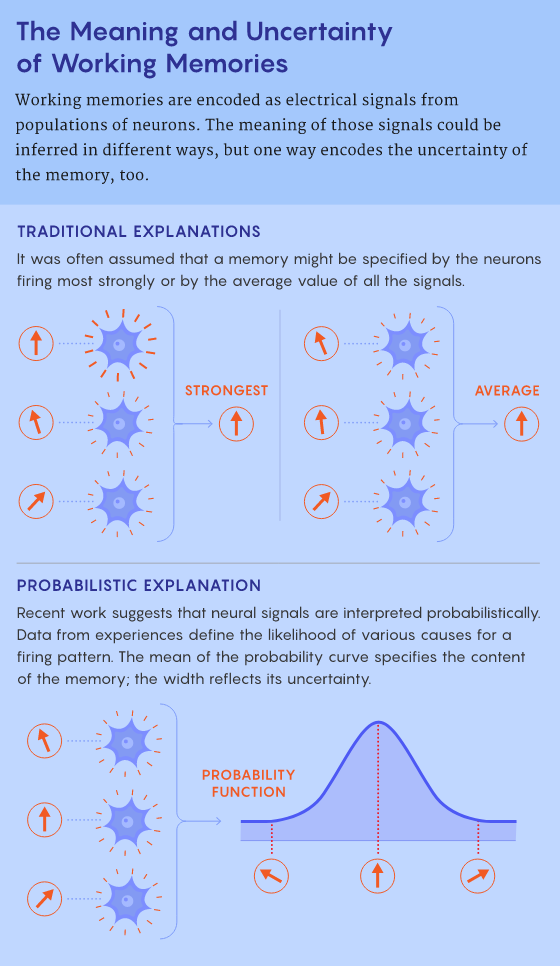
…the idea that we are walking around with probability distributions in our heads all the time has a certain beauty to it. And it is probably not just vision and working memory that are structured like this, according to Pouget. “This Bayesian theory is extremely general,” he said. “There’s a general computational factor that’s at work here,” whether the brain is making a decision, assessing whether you’re hungry or navigating a route.
link
FIML practice works precisely with the probabilistics of working memory. If the range of doubt in a perception is stronger than normal, it may prompt a query. If the range is stronger than normal and may indicate danger, a query is more likely. It would make sense that our assessments of these factors would be Bayesian. When perceptions are psychologically important, any Bayesian analysis will require assessing the subjective context into which the perception enters, which implies further Bayesian analyses. It would be wonderful if we had machines that could do this for us, but they will only be invented years from now if ever. For now, we can use our own minds to accomplish this through FIML practice. If you can understand the linked article, you should be able to see the value of FIML which collapses a Bayesian probability curve into the certainty of a single point. Psychologically, when this is done hundreds of times, the results are extremely satisfying. ABN
 American Buddhist Net