AI will become a localized and optimized sub-set for each sector of the economy, requiring each major organization and corporation to adopt specific cost/benefit data libraries and networks for use and functionality.
At scale, a thousand coders each working on Gemini, ChatGPT, Anthropic, Grok, etc. will become 100,000+ software designers working inside companies to create personalized, targeted, bespoke AI data systems and networks; each system specifically tailored to the industry or sector of business. The intranet of internets will happen again.
Creating and selling AI system networks and integration functions that are personally tailored to highly specific company functions, creates an entirely new sector of the technology industry that has not even begun yet. [There’s an investment opportunity there]
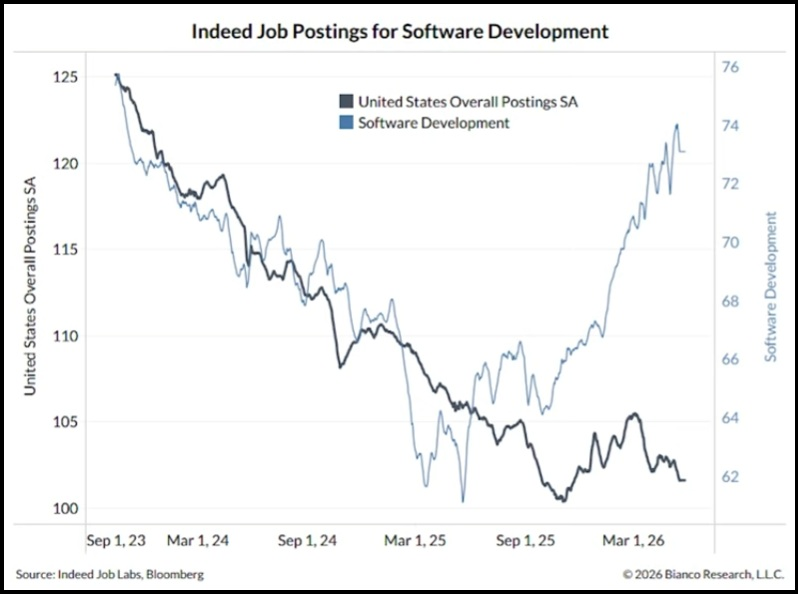
Will AI robots replace some repetitive human functions? Yes, the ice rink Zamboni will likely not have a steering wheel, just an emergency joystick. A reference for a comparative industrial scale Roomba vacuum, or the robotic pool cleaners. However, at scale the robotic industry is slower than human efficiency in almost all sectors that matter; the cost benefit analysis will limit growth. The maid service sector will not be impacted any more than the software developers (see chart above).
It is not an issue to fear some AI task efficiencies will grant more time available that will be filled with alternate task capabilities. Human productivity will increase in certain sectors of the economy, but humans will not lose work opportunities. Blue collar jobs will continue to expand as each of the hardware tools developed will need manufacturing, installation, maintenance and monitoring.
The further downstream the worker is from a repetitive function within the [XXXX] industry, the more irreplaceable they become; remember that.
As to the bigger picture of fully developed AI and the intersection of information and knowledge; yes, the automation of AI can present an issue. However, all AI concerns can be mitigated so long as multiple, alternative AI systems exist within the larger information realm.
As a nation we need dozens of different AI models each competing within the industry for the best AI product. As long as we have multiple AI systems, alternatives to the hive-mind, we do not need to fear the AI network as a source of information. If we don’t like the AI outputs, we can switch to an alternate AI provider.
If the subscription cost of the AI is too high, then as long as we have a competitive market where a lesser expensive, perhaps bespoke, AI option can exist, we should be okay. Let the free-and-fair market decide.
If AI outputs don’t offer empirical truth or real value to the end user, we should be fine as long as consumers have alternative options available. AI providers should be information providers in the same concept as cell phone providers. The key is to have multiple, competing AI systems available for industrial, business, professional and personal use.
On the upside of this information worry dynamic -in the pragmatic and optimistic perspective- we have the cost limiting nature of a massive singular AI information network.
A single AI central brain handling over 360 million users at once, all requiring identical responses that update with every tiny change in a multi-trillion datapoint-per-millisecond data stream, is far beyond the capacity of any computational AI system. The costs tied to such a setup are only now becoming clear, and AI business models are starting to fall apart in real time. This is a hard truth that isn’t going to change.
Within the AI business, those who can carefully write AI input instructions to achieve maximum value in AI output -industry by industry- will become increasingly more valuable. Those who can train AI to be cost effective -and provide materially beneficial outputs- within their granular sector of business, within each company, will become priceless to the organization. Wage rates will follow competency.
As noted by David Sacks in this segment highlighted below, the one key about AI to emphasize is the need for multiple competing models. If China (hive mind) has their model, and Europe (another hive mind) has their model, and the United States (entrepreneurial competitiveness) has multiple competitive models – we will win and simultaneously we will retain freedom.
What we don’t want is a singular AI model to win the support of the United States government and then end up with an AI regulatory system where they start defining terms of “safety” to eliminate information adverse to the interests of the government that regulates it. Both China and Europe will predictably do that.
This essay provides a very good overview of what is possible for future AI and what we probably can expect. I have excerpted most of it with the author’s permission. I left out the introduction as it refers to personal stuff readers of ABN may not be familiar with. ABN
Much of the work done in human semiotics involves analyses of semiotic codes.
Semiotics and semiotic codes are often treated like language or languages for which a grammar can be found.
One obvious problem with this sort of approach is semiotics indicates a set that is much broader than language. Stated another way, language is a subset of semiotics.
Human semiotics also include music, imagery, gesture, facial expression, emotion, and anything else that can communicate either within one mind or between two or more minds.
It is very helpful to analyze semiotic codes and it is very helpful to try to figure out how cultures, groups, and individuals use them. We can compare the semiotics of heroism in Chinese culture to that of French culture. Or the semiotics of gift-giving in American culture to that of Mexican culture. We can analyze movies, literature, science, and even engineering based on semiotic codes we have abstracted out of them.
We can do something similar for human psychology.
Analyses of this type are, in my view, general in that they involve schema or paradigms or grammars that say general things about how semiotic systems work or how individuals (or semiotic signs themselves) fit into those systems.
This is all good and general analyses of this sort can be indispensable aids to understanding.
General semiotic analyses are limited, however, in their application to human psychology because such analyses cannot effectively grasp the semiotic codes of the individual. Indeed general analyses are liable to conceal individual codes and interpretations more than usefully reveal them.
This is so because all individuals are always complex repositories of many general semiotic codes as well as many individual ones. And these codes are always changing, responding, being conditioned by new circumstances and many kinds of feedback.
Individuals as repositories of many codes, both external and internal, are complex and always changing and there is no general analysis that will ever fully capture that complexity.
For somewhat similar reasons, no individual acting alone can possibly perform a self-analysis that captures the full complexity of the many and always-changing semiotic codes that exist within them.
Self-analysis is far too subject to selection bias, memory, and even delusion to be considered accurate or objective. The individual is also far too complex for the individual to grasp alone. How can an individual possibly stand outside itself and see itself as it is? Where would the extra brain-space come from?
How can a system of complex semiotic codes use yet another code to successfully analyze itself?
Clearly, no individual human semiotic system can ever fully know itself.
To recap, 1) there is no general semiotic analysis that will ever capture the complexity of individual psychology, and 2) no individual acting alone can ever capture the complexity of the semiotic codes that exist within them.
Concerning point two, we could just as well say that no individual acting alone can ever capture the complexity of their own psychology.
We are thus prevented from finding a complex analysis of human psychology through a general analysis of semiotics and also through an individual’s self-analysis when acting alone.
This suggests, however, that two individuals acting together might be able to glimpse, if not grasp, how their complex semiotic codes are actually functioning when they interact with each other. If two individuals working together can honestly observe and discuss moments of dynamic real-time semiotic interaction between them, they should be able to begin to understand how their immensely complex and always-changing psycho-semiotic codes are actually functioning.
An approach of this type ought to work better for psychological understanding of the individuals involved than any mix of general semiotic analyses applied to them. Indeed, prefabricated, general semiotic analyses will tend to conceal the actual functioning of the idiosyncratic semiotics and semiotic codes used by those individuals.
The FIMLmethod does not apply a general semiotic analysis to human psychology. Rather it uses a method or technique to allow two individuals working together to see and understand how their semiotics and semiotic codes are actually functioning. ABN
Iris Chang’s *The Rape of Nanking: The Forgotten Holocaust of World War II* delves into the horrific events surrounding the 1937-1938 Nanjing Massacre, during which Japanese soldiers allegedly committed widespread atrocities against Chinese civilians. Published in 1997, the book sparked significant controversy and debate, particularly in the United States and Japan. While it received praise from various media outlets, it also faced criticism for its historical accuracy and reliance on secondary sources rather than primary documentation. The book’s vivid descriptions of the alleged atrocities, including mass killings and rampant sexual violence, were met with skepticism by some historians, who questioned the veracity of the figures and events described.
Despite the controversies, Chang’s work undeniably reignited discussions about the Nanjing Massacre and its implications for historical memory and international relations. Influential figures like George Will praised the book for encouraging academic discourse and raising awareness about Japan’s wartime actions. Critics, however, pointed to significant gaps in Chang’s narrative, questioning why prominent Chinese leaders like Mao Zedong and Chiang Kai-shek did not leverage the alleged evidence of Japanese atrocities to further their political agendas. This omission raised doubts about the credibility of Chang’s claims, leading some scholars to speculate that she may have exaggerated certain details or lacked adequate corroborating evidence.
The book’s reliance on secondary sources and sensationalist claims drew comparisons to other controversial works, such as Daniel Jonah Goldhagen’s *Hitler’s Willing Executioners*, which faced similar backlash for its historical inaccuracies. Scholars have argued that Chang’s narrative is further undermined by its failure to consider broader historical contexts and alternative accounts of events. For instance, the work does not address incidents like the Tongzhou Incident, where Chinese soldiers committed atrocities against Japanese civilians, which could complicate the simplistic portrayal of the Japanese as the sole perpetrators of violence during this period. Critics argue that Chang’s failure to include these details skews the historical narrative.
In the wake of Chang’s death in 2004, her book continues to evoke strong reactions. While some view it as a vital testament to the suffering endured by Chinese civilians, others argue it perpetuates a one-sided narrative that lacks scholarly rigor. The ongoing debate over the Nanjing Massacre illustrates the complexities of historical memory, national identity, and the interpretation of wartime events, revealing how narratives can be shaped by ideological perspectives and the political climate of the time. As discussions continue, the need for rigorous historical analysis and balanced perspectives remains crucial for understanding the lasting implications of these events in contemporary society.
The above is an AI summary provided by the website the article is posted on, The Unz Review. The article is worth reading as it reveals yet another area of significant historical dubiosity. Just as the present is so full of lies and mind-control it is nearly impossible to know what is really going on, so also is much of the past deeply uncertain and consequently often deeply misunderstood. ABN
I highly recommend these two videos. They provide an excellent explanation of Buddhist philosophy or world view without ever mentioning Buddhism.
The ‘small self’ of Buddhism is Kastrup’s ‘dissociated entity inside a Markov Blanket’. Kastrup’s ‘mind at large’ is Buddhist ‘ultimate reality’, ‘the Tathagata’, the ‘Buddha mind’, ‘enlightenment’, etc. The ‘doings’ of the entity inside the Markov blanket are karma. In this sense, those doings, or that karma (work), perpetuate a series of ‘rebirths’ rather than reincarnations. The Noble Eightfold Path is a concise way of describing the behaviors that lead to full realization of ‘mind at large’ or enlightenment.
Two of the (falsely understood) most ‘negative’ things in Buddhism are nicely cleared up in Kastrup’s description. The first is the mistaken notion that ‘nirvana’ or the ‘cessation of suffering’ is the cessation of being itself. Nirvana is ‘merely’ the return of the small self to ‘mind at large’, or the enlightenment of the small self to Buddha nature or ultimate reality. The second is karma is some kind of punishment administered by some kind of god thing. Karma is much more what Kastrup calls ‘doings’ and is simply a way to describe how what we do affects what we become.
I want to add that Nathan Hawkins does a wonderful job of interviewing Kastrup. He contributes a great deal to this conversation, which overall is not only a good description of Buddhism (without ever mentioning Buddhism) but also an excellent example of how people should talk. At one point, Hawkins says he wants to create a something like a ‘proto-religion’ that does not rely on ‘sacred texts’. He also says he wants philosophy to be more in touch with people’s lives as they are really lived. I like that a lot. It’s basically what basic Buddhism already is.
The Buddha said he was just a man; that he should not be worshiped; that his words are not sacred; that his teachings should be conveyed mind-to-mind (as in the videos above) and not turned into scared texts; and that each of us should make the teachings our own; learn them in our own languages and convey them to others generously when and if they want to hear them. I bet the Buddha would thoroughly enjoy and approve of the discussion above.
In a deeply Buddhist sense, there is no need for a Buddhist tradition. The whole thing could be thrown away and recreated. But why bother? Buddhism today is not a clinging to some sacred past or god-like figure, but a present iteration of a long tradition (which is largely philosophical) that dates back 2,500 years to the Sage of the Scythians, Shakyamuni Buddha. Watch the videos above and see what you think. ABN
UPDATE: I do not want to detract at all from Kastrup’s vision, but would like to say that, imo, Mind at Large or Ultimate Reality is much more like Mahayana on steroids than the philosophically guarded position Kastrup holds. He himself says he is conservative and sticks to ordinary interpretations like time and space and probably the existence of other civilizations and realms. I appreciate that he does that and why. Another point worth mentioning is the Markov Blanket each of us is ensconced in is surely semi-permeable. In that sense, a great deal of religious practice, including especially the samadhi states in Buddhism, can be understood as ways to make the Markov Blanket more permeable, to invite Mind at Large into our little cocoons. Prayer and religious ritual do that as well as does calling on God or practicing the presence of God. Moral actions, no matter how they are understood, that make us receptive to powers much greater than us are fundamental to human being and our comprehension of who and where we are. If we can comprehend Mind at Large viewing our lives through our eyes and senses, we can also comprehend having a very rich relationship with Mind at Large. In Buddhist terms, that might be described as us being drawn to the Tathagata to the point of never wanting to turn back. ABN
UPDATE: This is an interesting episode for several reasons. For non-Christians, it provides insights into both Catholicism and Evangelical, or Born Again, Christianity. With regard to Candace, it displays her bad side more than any other episode I have watched. She is a very good talker, and like all very good talkers can use speech with aggressive, devastating effect. For me, she went too far with Marx, who relies on emotional appeal more than rhetorical skill. He did come off as arrogant, especially in the beginning, but settled down considerably after about ten minutes. At that point, he sort of got the moral or histrionic upper hand over Candace, imo. He describes real experiences, does not appear to be a child abuser or trafficker and was reasonably polite toward Candace. Another side of this interview is it shows how powerful crowd-sourcing has become and how interesting people like Marx and Owens can be. I am a fan of Candace’s work and have praised her many times. I know very little about Marx. He also appears to be an interesting character but I doubt I will pay much attention to him unless something new happens. Lastly, from a Buddhist POV, I have to say both of these people embody a deep power which only Christians appear to have. They are both doing a lot; they are both forceful and generous personalities; they are both very much in this world, and also deeply immersed in their versions of spirituality. Most Buddhists are more withdrawn, even avoidant, and most of us do not do stuff nearly as passionately and with such perseverance as Christians. ABN
The analysis presented in the above video is the best alternative to the notion that Trump has gone crazy and is destroying USA and the world… I dislike making predictions because they turn thoughtful analyses into gambling, so I will not speculate about the future of the world. But if Trump is doing what Kokinda says, which appears to be the case, I hope he succeeds, and it appears he may very well do so. I hope readers of this site will at least listen to the argument above. ABN
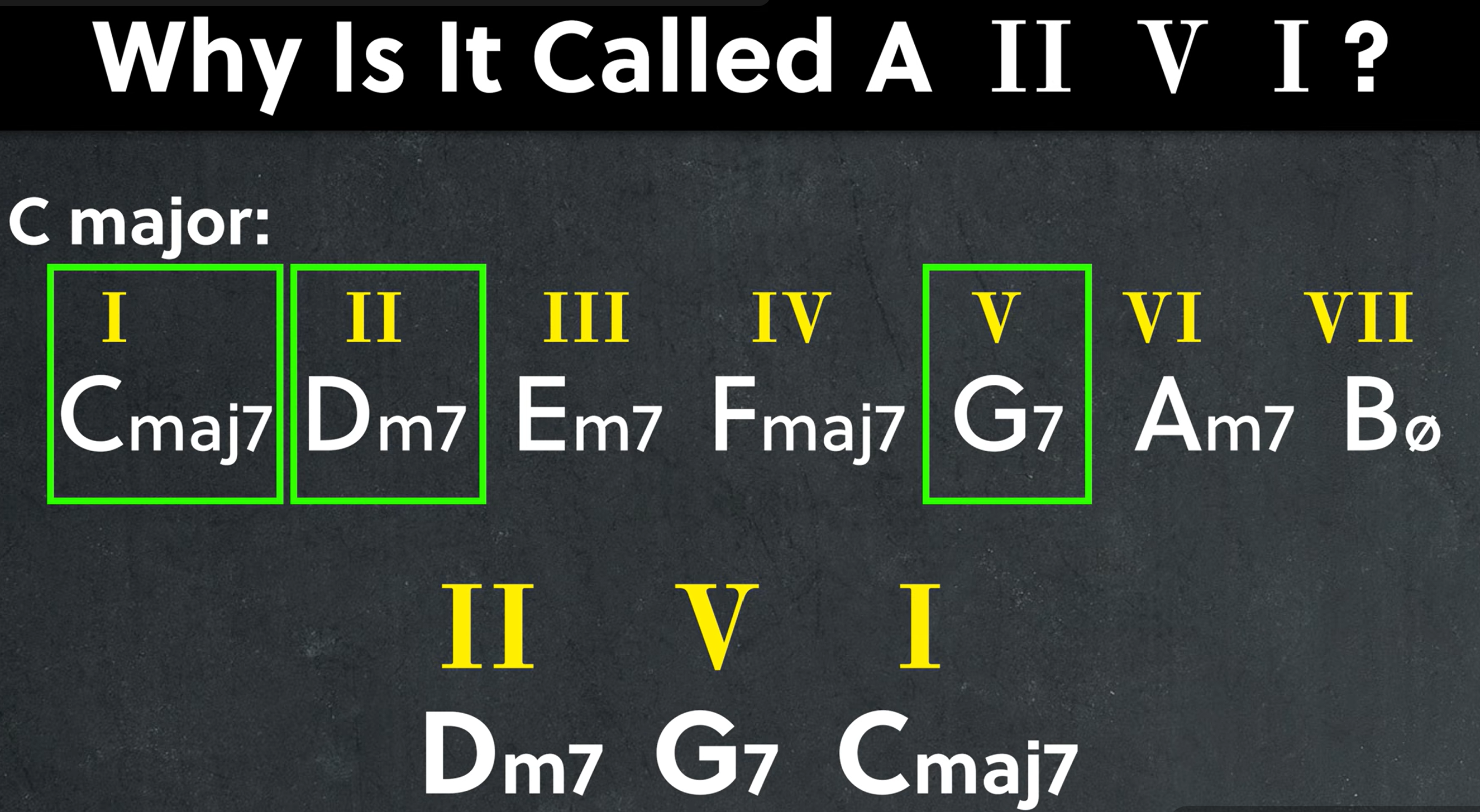
I learned something very helpful from this. He’s been playing guitar from a young age, and provides some ideas about how to think about improvisation in this short video. ABN

 American Buddhist Net