How to observe the semiotics that form the basis of your consciousness

A few days ago, I posted the essay, How semiotics can help us understand ourselves.

Today I want to discuss how you can grasp the semiotics that form the basis of your consciousness.

I am sure you already understand a good deal about yourself, but my guess is your understanding is probably in the form of a group of abstractions, such as—“my personality is thus-and-so”; “since I had this sort of childhood/education/etc., I am now outgoing/fearful/frugal/etc.”; “I believe in personal responsibility/behavior/etc.”; “my mom was a religious nut so I am an atheist, etc.”

In the post cited above, we used the terms signaling system and semiotics more or less interchangeably. A signaling system emphasizes what the message is and how it is sent, while semiotics emphasizes how the message is interpreted.

If we think of our minds as being signaling systems that are constantly referring to whatever semiotics we interpret as “true” or “real,” we can get a very good idea of how they function in the moment by observing what they are referring to in “the moment” (1-10 seconds, or so). By observing our minds closely, we can learn what semiotics cause us to have emotional responses or to interpret things in the ways we do. We can see how our mental/emotional signaling system builds up within us the appearance of a self with a biography, a personality, needs, fears, desires, goals, and so on.

If, for example, at some point in your life you learned and accepted as real a semiotic that you are stupid, you can spend hours, even decades, analyzing your feelings without getting any results. But if you can actually watch your mind as it signals to itself the semiotic “I am stupid,” and if you can see while that is happening that the signal is a mistake, then your mind will tend to stop sending you that signal.

If you can repeat that experience a few times—that is, catch that same mistake a few times—your mind will almost certainly stop wasting its resources thinking you are stupid. It will do this almost effortlessly because the mind is efficient and won’t waste time doing something it knows is a mistake.

So how do you do that, how do you catch the mistakes? You probably have already tried to catch them through introspection, reading, or discussing them with friends with less than satisfying results.

And what’s even harder to do is catch mistakes that you are not even aware of. How do you catch them?

I don’t think you can do it all by yourself. And I don’t think you can make satisfying progress by discussing these matters even with very wise friends. You can’t do it yourself because you can’t see yourself, and you can’t do it through long discussions because the signalling system works too quickly for that.

If you don’t cut in quickly and observe what it is doing, you won’t be able to change it easily.

Here is a way to look at that. Have you ever had a clock or mirror on the wall that was removed; maybe the mirror fell or the clock broke. At some point, the object that you had been used to seeing for years was gone. For some time after that, you probably turned unconsciously more than a few times to look at the now absent mirror or clock. That gives a strange feeling because at moments like that we see how deeply unconscious signs (the clock or mirror) affect our sense of who we are.

After a while we get used to the bare wall, but the lesson in how deeply signs operate within us should be clear. The other lesson of how we can indeed change our reference or expectation from a wall with a clock or mirror to a wall without either should also be clear.

At first, the mind is surprised, but after a while, it accepts that there is no clock on the wall with little fuss.

When two people do FIML (note: this link will lead to recent posts and reposts, including this one, but just scroll down a bit for more) practice, they help each other remove broken clocks and mirrors from the walls of their minds. FIML strongly emphasizes catching the signal and the semiotic it is referring to as quickly as you can. If partners can isolate their signals quickly, they will find that they are dealing with very small and discrete signs that very, very often are not true.

Normal people live in vague worlds where they grope toward each other like ghosts in the fog. How can we understand each other or ourselves if we do not pay attention to the small signals that are, arguably, the most important units of interpersonal communication?

And how can you pay attention to them if you don’t catch them quickly in the moment? If you try to understand yourself through long explanations and stories, you will only be understanding the underlying semiotic library that your moment-by-moment signals are referring to. If you catch those small signals as they happen in the moment, though, you will come to understand how and why that library is being accessed and how that affects you.

When your partner shows you that one of your signals was wrong and that it was referring to a part of the library that had no proper bearing on that moment, and when they show you that again, and again, that particular signal will stop firing. And there is a very good chance your library will change as well. It will change you deeply to see that.
first posted SEPTEMBER 14, 2012

More thoughts on “Empathy”

It seems that many individuals who self-describe as “empathetic” think of empathy as a talent they have for “reading people”, or knowing what others are thinking without having to ask. I think this is a huge mistake that can actually lead such people to have less empathy over time. To me it seems much more appropriate to think of empathy not as a talent one possesses but as a desire to understand other people. If we think of it this way then the ever-problematic “I know” becomes “I want to know.”

If empathy is conceived as an interest or desire, it is more likely to be developed and pursued. If, however, it is conceived as a static quality or talent, it will be taken for granted, misapplied, and probably warped into just another form of hubris.

I wonder what a self-described “empathetic” might learn from FIML. I have a feeling many of them would find that they’re not so good at “reading” others after all. Perhaps they are just adept at getting along in some sort of professional capacity and have generalized their confidence about that to other social realms.

As FIML has shown me and my partner over and over again, we are comically substandard at knowing what the other is thinking. But I hope the fact that we want to know means we have empathy for one another.

Be sure to read or re-read our previous post entitled “Theory of Mind and FIML” for a much more comprehensive treatment of this subject.

first posted  

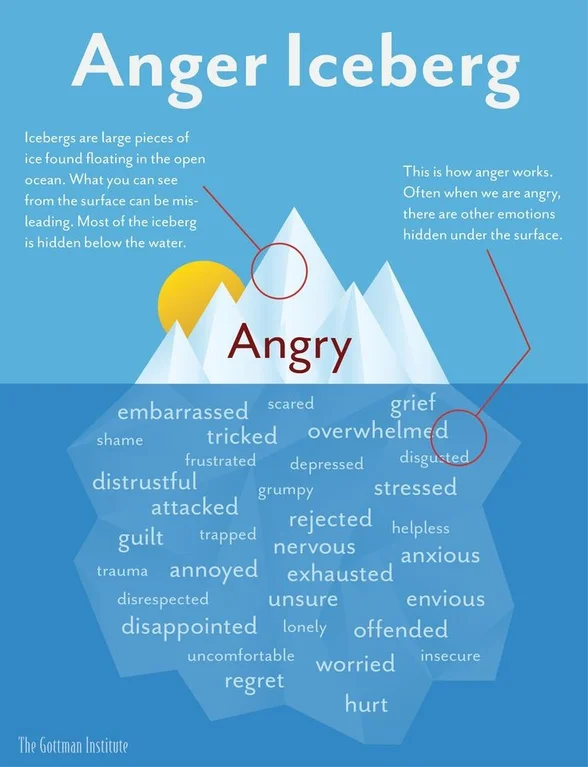
This image is profoundly misleading because it leaves out a major factor

A major cause of anger and all other emotional reactions during interpersonal communications is mistaken interpretations, either wrong or distorted. This can also include positive interpretations.

For Buddhists, the second skandha (sensation) is the proximate cause of how we perceive (third skandha) forms (first skandha). The fourth and fifth skandhas (mental activity and consciousness) are how we consolidate or more often reconsolidate the original mistaken or distorted sensation. For more on this see: The Five Skandhas.

For non-Buddhists, if you watch your mind closely you will notice there is a short delay between receiving an impression and reacting to it, interpreting it.

For everyone, if you can be mindful of the second skandha (sensation) as it occurs and then interrupt the habitual firing of the next three skandhas by doing a FIML query, you will begin to truly observe how your mind (and your partner’s mind) really works. Each interruption of this type improves your mental and emotional functioning because you will observe an objective bit of reality and correct toward it. For more information see: Disruption of neurotic response in FIML practice and How the brain processes new information. ABN

Today is the anniversary of my double mastectomy. 4 years ago today I chose to get my tits chopped off. At the time I thought it was the greatest day of my life. My dysphoria and my suicidal ideation disappeared when I saw my flat chest. I had a bad infection that took 🧵

Today is the anniversary of my double mastectomy. 4 years ago today I chose to get my tits chopped off. At the time I thought it was the greatest day of my life. My dysphoria and my suicidal ideation disappeared when I saw my flat chest. I had a bad infection that took 🧵

Two rounds of antibiotics to heal. I also lost a nipple which hurt real bad. I know I could get one tatted on but I want my own nipple. After care was done mainly in my own. The surgeon saw me twice after surgery for a cursory look. He didn’t even notice my nipple 🧵

Falling off. I had to point it out to him. As time went on I began to regret the top surgery. I wish I had never got it. Sure I could get implants but it wouldn’t be my real breasts plus implants only last so long before having to be replaced. So flat chest it is. 🧵

The kicker to everything is that my friend who took care of me after surgery was arrested shortly after my top surgery for r*ping women. She would offer drunk girls at the bar rides home and take advantage of them. This is someone who saw me at my most vulnerable. 🧵

So top surgery has it’s complications too. I wouldn’t recommend it to anyone if you’re breasts are healthy. I wish the doctors and therapist I had would have asked me more questions instead of being so quick to affirm me. Affirmation feels good but it doesn’t treat the patient.

Originally tweeted by Mary 🦎 (@fandaflames) on August 31, 2022.

Silenced healthcare workers speak out publicly for the first time

Here is a quick summary of some of the things they said:

  1. They are afraid to come out publicly due to intimidation tactics such as loss of job and/or license to practice medicine.
  2. Unvaccinated healthcare workers are extremely upset with the medical community. They feel they have been treated unfairly.
  3. It is the vaccinated workers who are getting sick with COVID, but it is the unvaccinated who are punished with constant testing, restrictions, and threats of losing their jobs.
  4. The COVID shots are a disaster. Even for the elderly which is supposed to be the most compelling use case, death rates in elderly homes went up by a factor of 5 after the shots rolled out. Each time the shots are given, the deaths spike. Nobody is talking publicly about this. It’s not allowed.
  5. Doctors are seeing rates of injury and death increase dramatically in all ages of people. The injuries are only happening to the vaccinated. There is no doubt that this is happening but many doctors have so much cognitive dissonance that they don’t see it.
  6. One nurse with 23 years of experience says she’s never heard of anyone under 20 dying from cardiac issues until the vaccines rolled out. Now she knows of around 30 deaths.
  7. “I have been a nurse for 36 years. I have NEVER witnessed people in their 20s and 30s having strokes, atrial fibrillation, or cardiomyopathies until the Covid vaccines. I work in cardiology. When I mention that someone should look at the vaccines as a possible reason, I am immediately silenced and told, “It is NOT from the vaccine.””
  8. Doctors aren’t recording vaccination status in the medical records so that all the deaths are attributed to the unvaccinated.
  9. Doctors are deliberately ignoring the possibility that the vaccines could be the cause of all the elevated events. The events are simply all unexplained.
  10. Many doctors have either quit or will quit.
  11. Some doctors and nurses at top institutions such as Mass General Hospital have falsified vaccine cards. They publicly toe the line and encourage their patients to take the shot knowing full well it is deadly. They value their job more than the lives of their patients. The important thing is they are risking 10 years in jail for doing this. These highly respected medical workers are telling the world that these COVID shots are so dangerous that they are willing to risk 10 years in prison to avoid taking the shot. That’s the message America needs to hear. And if Biden were an honest President, he would call for full amnesty and protection from retaliation for all these cases if people admitted publicly they did this. He’d be amazed at the number of responses he’d get. But he won’t do that because it would be too embarrassing for his administration.

link to original

All of the above is from Steve Kirsch’s post linked just above. ABN

do your best

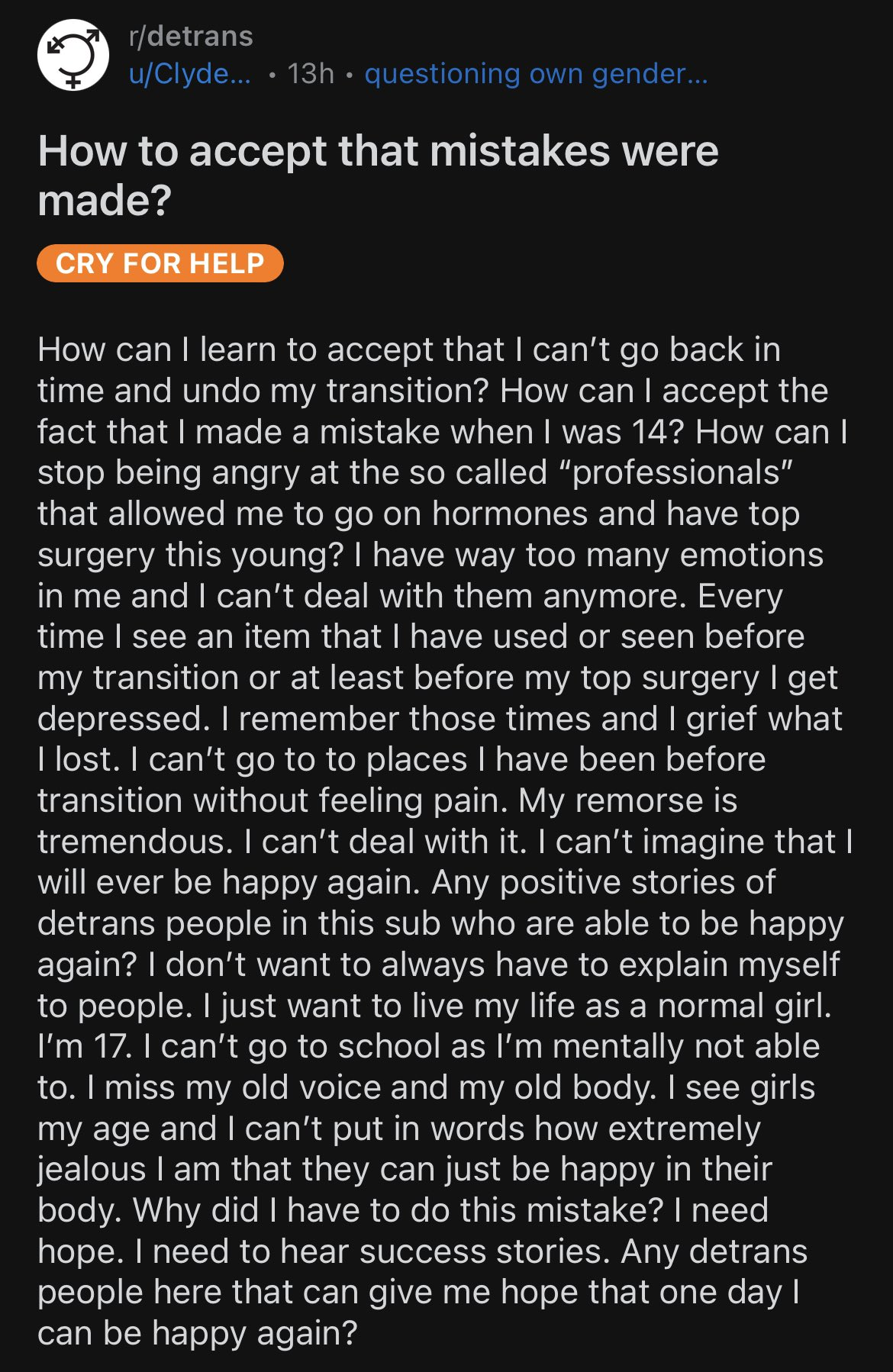
You have fully experienced seeing through the illusion of self. You made that decision at such a young age it can hardly be considered your decision, but that’s what happened and you are the one who has to live with it now. Having myself experienced a different but extremely serious trauma at almost exactly your age (I was 13), I can fully relate to your sadness. The success that can be derived from experiences like these is the success of seeing beyond the worldly ego. You can’t possibly go back, so accept it. From now on always do your best. Use your deepest mind to understand your conditions as deeply as you can, and then do your best based on that understanding.

If the person who wrote the above sees this, I hope she will understand and feel some comfort even if it seems hard to do. Deep trauma and huge mistakes can and do make us stronger and realer. There is no external consolation prize for trauma and no gain to be had by playing the victim, but there is a profound inner payoff. ABN

Personality as persona

The word persona comes from Latin, where it originally meant a “theatrical mask.” In everyday usage today, we normally mean it to indicate a “social role” that, to some extent, most of us play consciously.

Carl Jung used the concept of persona to indicate the deep sense in which a person employs conscious and subconscious methods to present a social face, or mask, to the world.

Jung said of his use of the word persona that it is “a kind of mask, designed on the one hand to make a definite impression upon others, and on the other to conceal the true nature of the individual.” (C. G. Jung, Two Essays on Analytical Psychology London 1953 p. 190)

My understanding of Jung’s psychology is that he took the persona to be something more substantial—more real—than it need be. In my view, when we take our persona(s) too seriously, we reify them, even fetishize them.

Once fetishized or reified, the persona in Jungian psychology takes on almost supernatural qualities, eventually requiring “disintegration” followed after some time by “restoration” as a more conscious and reasonable thing that can serve both personal and social needs without painful contradictions.

I believe this Jungian sense of the term persona has had a considerable influence on our ordinary sense of what a personality is.

In this light, I would contend that what we commonly refer to as personality is a ghostly generalization that obscures both inner-private and outer-social reality.

Belief in “personality” removes analysis of interpersonal-being-in-this-world from actual specifics to nebulous generalities.

If you have a conflict or misunderstanding with a friend and either of you believes it is due to “personality differences,” you will tend to avoid the problem rather than fix it. You will avoid it because it is all but impossible to fix anything with such a vague notion as personalty.

Assuming the two friends just mentioned are close friends, they would do much better to identify the specific moment their misunderstanding occurred and work with that.

People today do not normally do this for two reasons: 1) almost everyone believes in something like “personality” and in so believing makes it impossible to fix even small moments of discord, and 2) very few people know how to fix those sorts of problems even if they do realize that more is going on than two ghostly persona clashing in a mystical realm.

I agree that people need personas to negotiate many social and professional environments. And I agree that most people have a few traits that often remain sort of constant over time and in similar contexts.

What I do not agree with is everything else we normally attribute to personalities. In place of all that, I would substitute the idea that humans are semiotic entities and that we communicate with each other and within ourselves by using semiotics and semiotic networks.

Our interests and training lead us to emphasize some parts of these networks over others, but this does not constitute a “personality” as the word is normally used.

Suffering arises when we experience bad communication. Belief in personalities masks (ironically) the true nature of communication problems. Belief in personalities causes us to generalize when we should be looking very closely at the specific moment during communication that the semiotic networks of the two (or more) communicators began to diverge.

That is the point at which their interpretations began to differ and nothing will explain why they began to differ except close analysis of that precise moment.

People do not analyze the precise moment their interpretations of each other began to differ because they do not know how. In place of analysis, people almost always generate strong emotions and within seconds make it impossible to analyze anything.

It is not your personality or theirs that does this. It is, rather, our lousy abilities to communicate, a problem everyone in the world has. We are like monkeys in a high-powered automobile all but doomed to crash, or go nowhere.

How to drive that car? How can we catch the specific moment interpersonal interpretations diverge? And how can we analyze that moment? Only FIML practice or something very much like it will allow us to do that.

Wasting time analyzing your personality or constructing an even better one will get you nothing more than a theatrical mask, a persona, that will be useful in some social situations but a disaster in all close interpersonal relationships.

first posted APRIL 17, 2014

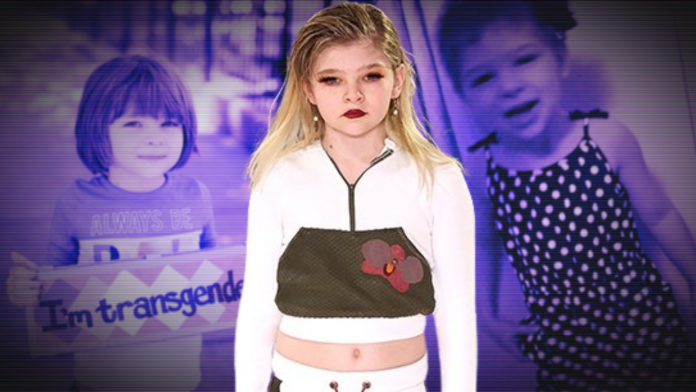
World’s Youngest Trans Model Has Two Trans Parents, Will Have “Gender Surgery” At 16

A 10-year-old child is making headlines as the world’s youngest trans model to walk the runway at New York Fashion Week after representing the Trans* Clothing Company brand.

Noella McMaher was a model at New York Fashion Week in February, but the child’s story has begun to receive additional media attention after it was announced that the 10-year-old had been signed on for modeling gigs until November.

According to Noella’s parents, the child began expressing gender dysphoria around age 2.

Referring to the boy using feminine pronouns, Noella’s mother stated: “She would refuse to wear boy clothes and have tantrums because she was so young. She knew what she wanted, but didn’t have the words to say it … I should have known earlier, as she hated anything masculine, so I brought her to a gender clinic.”

link

The whole article provides background information detailing how wrong this is:  Dr. Sapir noted: “Schools are not being ‘supportive’ or ‘inclusive’ when they adopt ‘affirming’ policies. Instead, they are potentially changing the course of psychosocial development and putting kids on track to becoming sterile, sexually dysfunctional, and lifelong wards of the medical industry.” ABN

“You just have to make sure that the masses exhaust themselves, destroy themselves before they destroy you” ~ Mattias Desmet

So very true. A powerful message for those of us who really know the truth. Don't give up and don't lose hope

This video clip was from a show called, "The Last Wake Up Call". My apologies. Forgot to include that in my original post.

Sorry my apologies, this clip was taken from a Telegram account called, "The Last Wake Up Call". It's been a long day lol so again I'm sorry for the mixup.

Originally tweeted by Aidan Lucid (@TheZargothian) on August 19, 2022.

EXCLUSIVE: Leaked files expose how U.S. pediatricians accuse their own professional body of pushing a ‘harmful’ drugs-first approach on trans teens — and of deliberately BLOCKING moves to change the rules

  • DailyMail.com obtained leaked files that expose how rank-and-file pediatricians are slamming their academy for pushing puberty-blocking drugs on teens who identify as transgender
  • The American Academy of Pediatrics causes ‘great harm’ with drug cocktails to youngsters, member says 
  • Top youth medical body pushes ‘unsafe and unsustainable’ policies based on ‘scant and shoddy’ evidence, says another
  • New AAP rules blocked a resolution calling for a policy rethink at annual meeting in Chicago
  • AAP says its policies are evidence-based, widely accepted, subject to review, and best bet for vulnerable teens
  • Critics say the academy has bowed to pressure from ‘young activist doctors’  
  • Did you suffer from bad transgender care? Email James.Reinl@mailonline.com
link

Good article, worth reading. Looks like another medical fiasco of control from the top through censorship and intimidation. Top-down control is what corralled one million US doctors into covid obedience. In Buddhism no mundane “identity” is inherently real in itself. All of them are empty, devoid of self or “own being.” Thus medically changing your body to “correct” it to fit an ephemeral notion of “identity” is on its face an egregious mistake, an act of delusion with potentially very serious consequences. To encourage a young person to take harmful medication or to undergo destructive surgery to fulfill a delusive fantasy of this sort is not right. For a doctor to do this, worse for a pediatrician to do this, is a grave act of malpractice especially when the AAP is deliberately avoiding public, transparent, scientific debate on this very serious matter. ABN

EXCLUSIVE: Leaked files expose how U.S. pediatricians accuse their own professional body of pushing a ‘harmful’ drugs-first approach on trans teens — and of deliberately BLOCKING moves to change the rules

  • DailyMail.com obtained leaked files that expose how rank-and-file pediatricians are slamming their academy for pushing puberty-blocking drugs on teens who identify as transgender
  • The American Academy of Pediatrics causes ‘great harm’ with drug cocktails to youngsters, member says 
  • Top youth medical body pushes ‘unsafe and unsustainable’ policies based on ‘scant and shoddy’ evidence, says another
  • New AAP rules blocked a resolution calling for a policy rethink at annual meeting in Chicago
  • AAP says its policies are evidence-based, widely accepted, subject to review, and best bet for vulnerable teens
  • Critics say the academy has bowed to pressure from ‘young activist doctors’  
  • Did you suffer from bad transgender care? Email James.Reinl@mailonline.com
link

Good article, worth reading. Looks like another medical fiasco of control from the top through censorship and intimidation. Top-down control is what corralled one million US doctors into covid obedience. In Buddhism no mundane “identity” is inherently real in itself. All of them are empty, devoid of self or “own being.” Thus medically changing your body to “correct” it to fit an ephemeral notion of “identity” is on its face an egregious mistake, an act of delusion with potentially very serious consequences. To encourage a young person to take harmful medication or to undergo destructive surgery to fulfill a delusive fantasy of this sort is not right. For a doctor to do this, worse for a pediatrician to do this, is a grave act of malpractice especially when the AAP is deliberately avoiding public, transparent, scientific debate on this very serious matter. ABN