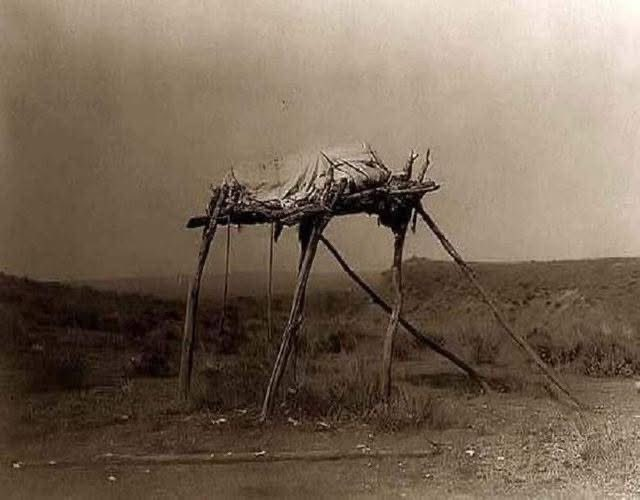
This is a classic Plains Indian burial scaffold — a raised platform of poles built so the dead could rest above the earth, out of reach of wolves and scavengers, and closer to the sky — WindTalker
Many of the great tribes of the northern and central Plains practiced this form of aerial burial. The Lakota, Dakota, and Nakota (Sioux), Crow, Cheyenne, Mandan, Assiniboine, Blackfeet, and Gros Ventre all used it at different times and in different places. When suitable trees were available, bodies were sometimes placed high in the branches instead. The same idea guided both methods.
The body was carefully wrapped in robes, blankets, or skins and laid on the platform, often with the person’s most important belongings: weapons, tools, a favorite pipe, food, tobacco. Sometimes the heads and tails of horses were fastened to the poles so the spirit would have mounts for the journey. Orientation mattered. Crow people commonly placed the feet toward the east. Mandan often directed them southeast, toward the old country around the Heart River.
The reasons were both practical and spiritual. In winter the ground could freeze solid for feet. Wolves and dogs would dig up shallow graves. A scaffold kept the body clean and intact while the spirit made its way. Relatives could still visit, speak to the dead, and leave offerings. Some groups later collected the cleaned bones for secondary burial in the earth, in rock crevices, or in special places near the village. The Mandan arranged the bleached skulls in careful circles on the prairie. Nineteenth-century travelers recorded these scenes in detail.
Karl Bodmer’s famous 1830s image of a Sioux chief’s funeral scaffold near Fort Pierre remains one of the clearest visual records. Later photographs from Crow and Dakota country show the same quiet platforms standing alone on open ground.
This was never a single uniform custom across all Native peoples. It belonged especially to the mobile horse cultures of the grasslands, where the horizon was wide and the relationship between the living, the dead, and the open sky was close. The scaffolds were temporary homes for the body while the spirit traveled on.


 American Buddhist Net